

 English
 中文简体
中文简体Content
- 1 What Does the Condensing Unit Do? The Short Answer
- 2 The Three Core Components Inside a Condensing Unit
- 3 How the Condensing Unit Fits Into the Full Refrigeration Cycle
- 4 Types of Condensing Units and Their Applications
- 5 How Condensing Unit Capacity Is Measured
- 6 Signs That Your Condensing Unit Is Not Working Properly
- 7 The Role of Refrigerant in Condensing Unit Performance
- 8 Condensing Unit Maintenance: What Actually Makes a Difference
- 9 How Outdoor Temperature Affects Condensing Unit Operation
- 10 Condensing Units in Commercial Refrigeration
- 11 When to Repair vs. Replace a Condensing Unit
What Does the Condensing Unit Do? The Short Answer
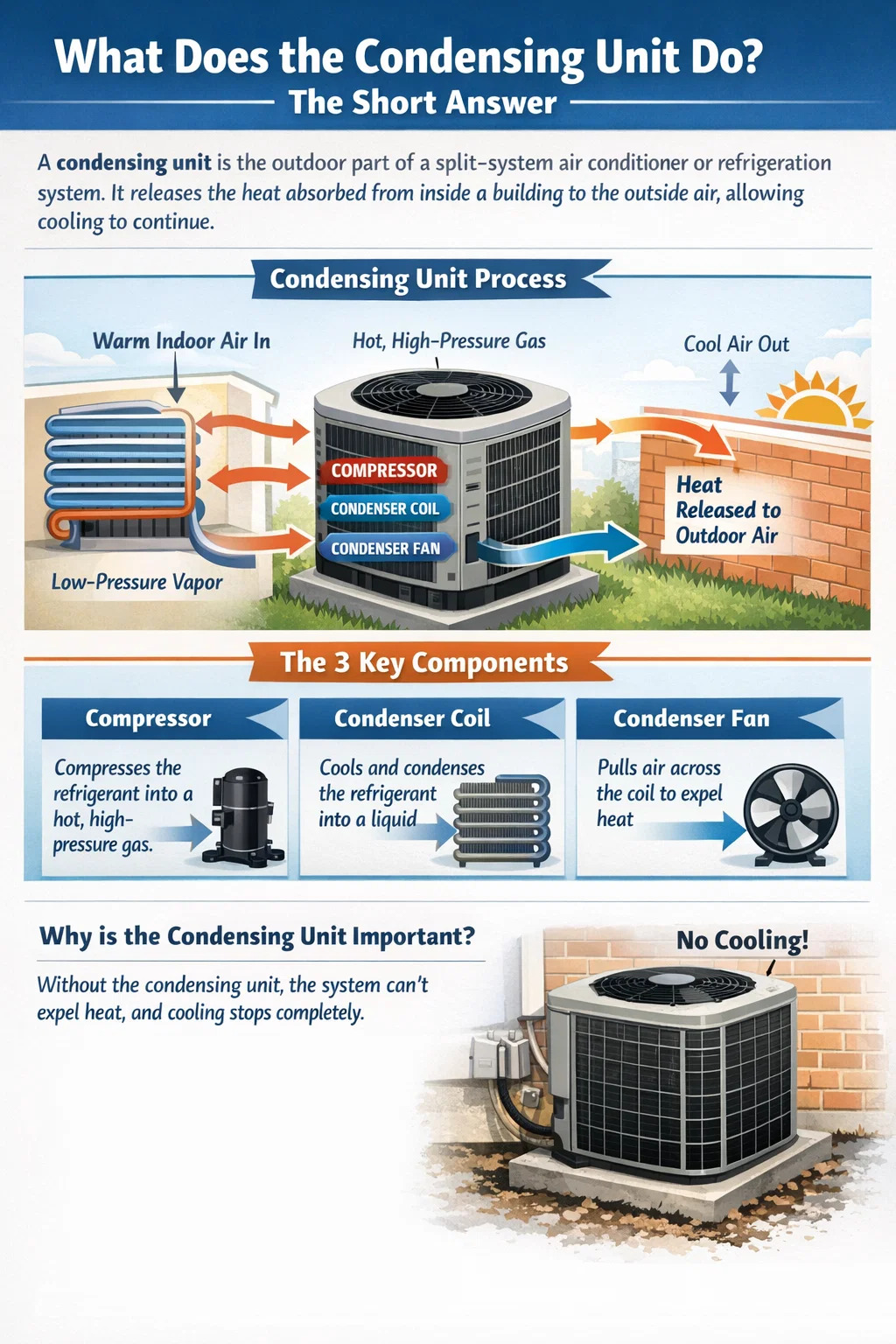
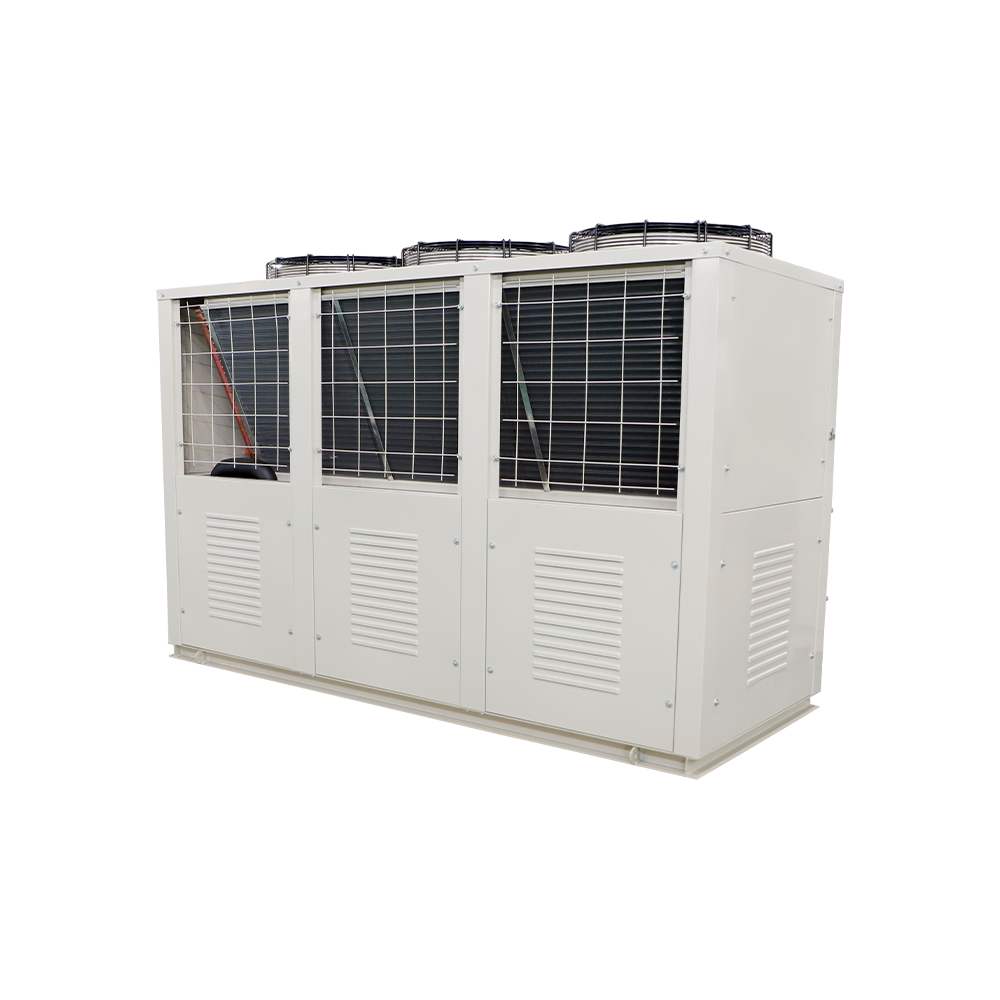
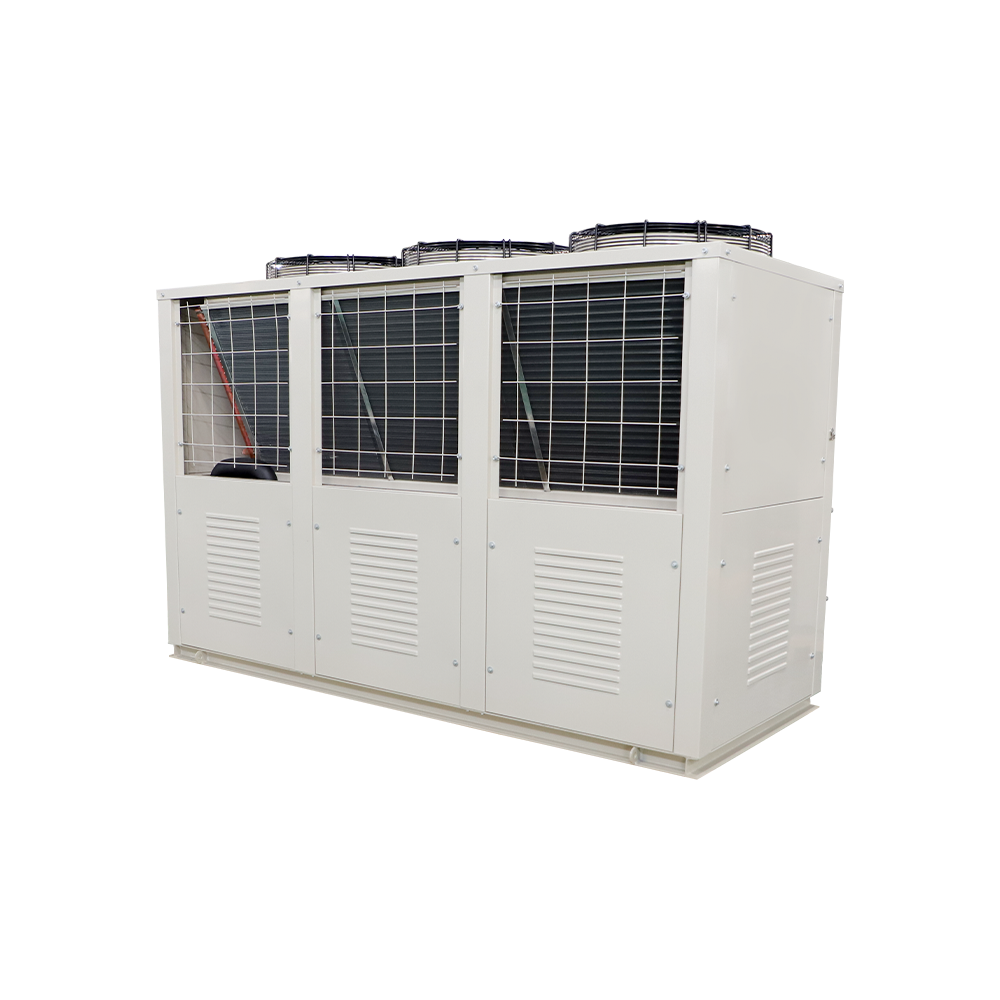
A condensing unit is the outdoor component of a split-system air conditioner or refrigeration system. Its primary job is to release the heat absorbed from inside a building or refrigerated space into the outdoor air, completing the refrigeration cycle so that cooling can continue. Without a functioning condensing unit, no heat can be expelled, and the entire system fails to cool.
More specifically, the condensing unit takes high-pressure, high-temperature refrigerant vapor coming from the compressor and converts it back into a liquid state by removing its heat. This phase change — from gas to liquid — is how heat exits the system. The unit then sends the cooled liquid refrigerant back indoors to absorb more heat, and the cycle repeats continuously as long as cooling is needed.
Three major components work together inside the condensing unit to make this happen: the compressor, the condenser coil, and the condenser fan. Each plays a distinct role, and a failure in any one of them can bring the entire cooling process to a halt.
The Three Core Components Inside a Condensing Unit
The Compressor
The compressor is the heart of the condensing unit and arguably the most expensive component in any HVAC system. It receives low-pressure refrigerant vapor from the indoor evaporator coil and compresses it into a high-pressure, high-temperature gas. This compression is what drives the refrigerant through the entire system and enables the heat exchange process to occur.
In residential systems, compressors typically consume between 1,000 and 4,000 watts of electricity depending on the unit's capacity. A failed compressor is usually the costliest repair in HVAC service — replacement can range from $800 to over $2,500, which is why compressor health is closely tied to the overall value of the condensing unit.
The Condenser Coil
Once the refrigerant is compressed, it flows into the condenser coil — a series of tubes surrounded by metal fins, typically made of copper or aluminum. As the hot refrigerant travels through these coils, it releases its heat into the surrounding air. The coil's large surface area maximizes heat transfer efficiency.
During this process, the refrigerant cools enough to change state from a gas back into a liquid. This is the condensation step that gives the condensing unit its name. The efficiency of this heat exchange is directly tied to how clean the coil is — a coil covered in just a thin layer of dirt or debris can reduce system efficiency by up to 30%, according to HVAC industry data.
The Condenser Fan
The condenser fan pulls ambient outdoor air across the condenser coil to carry away the released heat. Without the fan, the coil would quickly become saturated with heat and the refrigerant would not condense properly, causing the system's high-side pressure to spike dangerously.
Fan motors in residential condensing units typically run at 850 to 1,100 RPM and are engineered to operate continuously during cooling cycles. On very hot days when outdoor temperatures exceed 95°F (35°C), the fan works significantly harder, which is why high ambient temperatures can push a system to its performance limits.
How the Condensing Unit Fits Into the Full Refrigeration Cycle
Understanding what the condensing unit does requires understanding where it sits in the broader refrigeration cycle. The cycle has four main stages, and the condensing unit is responsible for two of them.
- Evaporation (indoors): The liquid refrigerant enters the evaporator coil inside the air handler or indoor unit. As it absorbs heat from the indoor air, it evaporates into a low-pressure vapor.
- Compression (condensing unit): The vapor travels to the outdoor condensing unit, where the compressor pressurizes it into a hot, high-pressure gas.
- Condensation (condensing unit): The hot gas flows through the condenser coil, releases its heat to the outdoor air via the fan, and condenses back into a liquid.
- Expansion (indoors): The liquid refrigerant passes through an expansion valve, its pressure drops sharply, and it re-enters the evaporator coil to absorb heat again.
This cycle repeats hundreds of times per day during peak cooling season. The condensing unit is engaged for steps two and three — the two most mechanically intensive parts of the process. This is why the outdoor unit runs loudly and consumes significantly more electricity than the indoor air handler.
Types of Condensing Units and Their Applications
Not all condensing units are the same. They vary by cooling method, application, and configuration. Choosing the right type matters significantly for efficiency and longevity.
Air-Cooled Condensing Units
These are the most common type found in residential and light commercial settings. They use ambient air — blown across the condenser coil by the fan — to remove heat. They are easy to install, require minimal maintenance, and are cost-effective. However, their performance drops noticeably when outdoor temperatures are high, since there is less temperature differential to drive heat transfer.
Water-Cooled Condensing Units
Instead of air, these units use water to carry away heat from the refrigerant. Water is a far more efficient heat transfer medium than air, which means water-cooled systems generally achieve higher efficiency ratings. They are commonly used in commercial buildings, hotels, and industrial facilities. The trade-off is the need for a cooling tower or municipal water supply, which adds infrastructure cost and water consumption considerations.
Evaporative Condensing Units
These units combine air and water cooling by spraying water over the condenser coil while air passes over it. The evaporation of water removes heat very efficiently, making these units well-suited to hot, dry climates. They can achieve 20–30% greater efficiency compared to standard air-cooled units under high ambient temperature conditions.
Remote vs. Integral Condensing Units
In split systems, the condensing unit is located remotely from the indoor evaporator — connected by refrigerant lines. In packaged or integral systems, the condensing unit and evaporator coil are housed in a single cabinet. Remote configurations are more common in residential HVAC, while packaged rooftop units are standard in commercial retail and office buildings.
| Type | Cooling Medium | Typical Application | Efficiency Level |
|---|---|---|---|
| Air-Cooled | Ambient Air | Residential, Light Commercial | Moderate |
| Water-Cooled | Water | Commercial, Industrial | High |
| Evaporative | Air + Water Mist | Hot/Dry Climates | Very High |
| Packaged/Integral | Air | Rooftop Commercial | Moderate to High |
How Condensing Unit Capacity Is Measured
Condensing units are rated by their cooling capacity, measured in tons or BTUs (British Thermal Units). One ton of cooling capacity equals 12,000 BTU per hour. Residential condensing units typically range from 1.5 tons to 5 tons, while commercial systems can reach 20 tons or more for a single unit, and industrial chiller plants use multiple units to achieve hundreds of tons of combined capacity.
Efficiency is measured by the Seasonal Energy Efficiency Ratio (SEER) rating. The higher the SEER, the less electricity the unit consumes per unit of cooling delivered. As of 2023, the U.S. Department of Energy requires a minimum SEER2 of 13.4 for residential split systems in the northern U.S. and 14.3 in southern regions. Modern high-efficiency condensing units can achieve SEER ratings of 20 to 26, which can cut electricity usage by 30–40% compared to older 10 SEER units.
Selecting a condensing unit that is either undersized or oversized for a given space causes problems. An undersized unit runs constantly without reaching setpoint temperatures, wearing out components faster. An oversized unit short-cycles — turning on and off too frequently — which prevents proper dehumidification, increases mechanical stress, and wastes energy.
Signs That Your Condensing Unit Is Not Working Properly
Because the condensing unit operates outdoors and often out of direct sight, problems can go unnoticed until cooling performance degrades significantly. Knowing the warning signs can prevent a minor issue from becoming a major failure.
- The unit runs but the home doesn't cool: This often points to a refrigerant leak, a failed compressor, or a severely fouled condenser coil preventing adequate heat rejection.
- Unusual noises: Grinding, rattling, or banging from the outdoor unit can indicate a failing compressor, a loose fan blade, or worn motor bearings.
- The condenser fan isn't spinning: A dead fan motor or failed capacitor can cause the fan to stop, leading to rapid overheating of refrigerant and system shutdown via high-pressure cutout.
- Ice forming on the outdoor unit or refrigerant lines: While icing on the indoor evaporator is more common, ice on the outdoor unit typically signals very low refrigerant charge or restricted airflow.
- Significantly higher electricity bills: A condensing unit working inefficiently — due to dirty coils, low refrigerant, or an aging compressor — can consume 20–50% more electricity than a well-maintained unit of the same size.
- Frequent circuit breaker trips: A compressor drawing too much amperage due to internal wear or a seized motor can repeatedly trip breakers, which is a clear indicator that professional service is needed immediately.
The Role of Refrigerant in Condensing Unit Performance
Refrigerant is the working fluid that carries heat from inside the building to the condensing unit. The type and charge level of refrigerant directly affects how well the condensing unit can do its job. Over the past two decades, the HVAC industry has shifted away from R-22 (Freon), which was phased out due to its ozone-depleting properties, toward R-410A and more recently R-32 and R-454B, which have lower global warming potential.
Refrigerant does not get consumed during normal operation — it circulates in a closed loop. A low refrigerant charge almost always means there is a leak somewhere in the system. Even a 10% undercharge in refrigerant can reduce system capacity by 20% and decrease efficiency significantly, forcing the condensing unit to work harder for less result. Overcharging refrigerant is equally harmful, as it raises head pressure and can cause compressor damage.
Only EPA-certified technicians are legally permitted to handle refrigerant in the United States. This is an important practical consideration when a condensing unit needs a refrigerant recharge — it is not a DIY task, and improperly handled refrigerant release carries legal penalties under Section 608 of the Clean Air Act.
Condensing Unit Maintenance: What Actually Makes a Difference
Proper maintenance of the condensing unit extends its service life and keeps operating costs in check. The average lifespan of a residential condensing unit is 15 to 20 years with good maintenance, but units that are neglected may fail within 10 years. Here is what maintenance actually involves and why each task matters.
Cleaning the Condenser Coil
Dirt, grass clippings, cottonwood seeds, and debris accumulate on the condenser coil's fins over time, blocking airflow and insulating the coil surface. Annual coil cleaning — using a garden hose or professional coil cleaner — is one of the single highest-return maintenance tasks. It restores airflow, reduces head pressure, and directly improves SEER performance.
Keeping Clearances Around the Unit
Manufacturers typically specify a minimum of 18 to 24 inches of clearance on the sides of a condensing unit and at least 4 to 5 feet above the fan discharge. Shrubs, fencing, or storage items placed too close restrict airflow, causing the unit to recirculate hot exhaust air rather than pulling in cool ambient air — a condition that can raise head pressure by 10–15 psi and dramatically increase energy consumption.
Checking Electrical Connections and Capacitors
The run capacitor provides the electrical boost that starts and sustains the compressor and fan motor. Capacitors degrade over time, especially in hot climates, and a weakening capacitor causes the compressor to draw excessive amperage. Annual electrical checks — including capacitor testing with a multimeter — catch this problem before it causes a compressor failure. A replacement capacitor typically costs $15–$50 in parts, while the compressor it protects may cost ten to fifty times more.
Inspecting Refrigerant Lines and Insulation
The refrigerant lines connecting the condensing unit to the indoor evaporator should be checked for oil stains (a sign of leaks), physical damage, and deteriorated insulation on the suction line. Damaged insulation allows the cold suction line to absorb heat from the outdoor environment before returning to the compressor, reducing system efficiency and potentially causing liquid refrigerant to return to the compressor — a condition called slugging that can destroy the compressor.
Scheduling Annual Professional Service
While homeowners can handle basic tasks like clearing debris and hosing off the coil, a licensed HVAC technician should inspect the system annually. They will check refrigerant charge, measure superheat and subcooling values, test electrical components, and assess compressor performance. Catching a developing problem in April — before the peak summer season — is far less expensive than an emergency service call in July when technician availability is limited and repair costs are higher.
How Outdoor Temperature Affects Condensing Unit Operation
The condensing unit's ability to reject heat depends entirely on the temperature difference between the hot refrigerant in the coil and the outdoor air temperature. When outdoor temperatures climb, this temperature differential shrinks, making heat transfer less efficient. This is why air conditioners struggle on the hottest days of the year — not because they are broken, but because the physics of heat transfer become less favorable.
At 95°F (35°C) outdoor temperature, most residential condensing units are operating near their rated capacity limits. Above 100°F (38°C), capacity typically drops 10–15% compared to performance at standard AHRI rating conditions (which use 95°F as the outdoor temperature standard). Some high-ambient condensing units are specifically engineered for desert climates and can operate effectively at outdoor temperatures up to 125°F (52°C).
The placement and orientation of the condensing unit can make a measurable difference. Units installed on the shaded north or east side of a building operate in cooler ambient conditions than units placed on a sun-baked west or south-facing wall. Studies have shown that direct solar exposure on a condensing unit can raise the effective ambient temperature by 10–15°F, meaningfully reducing efficiency during the hottest part of the day.
Condensing Units in Commercial Refrigeration
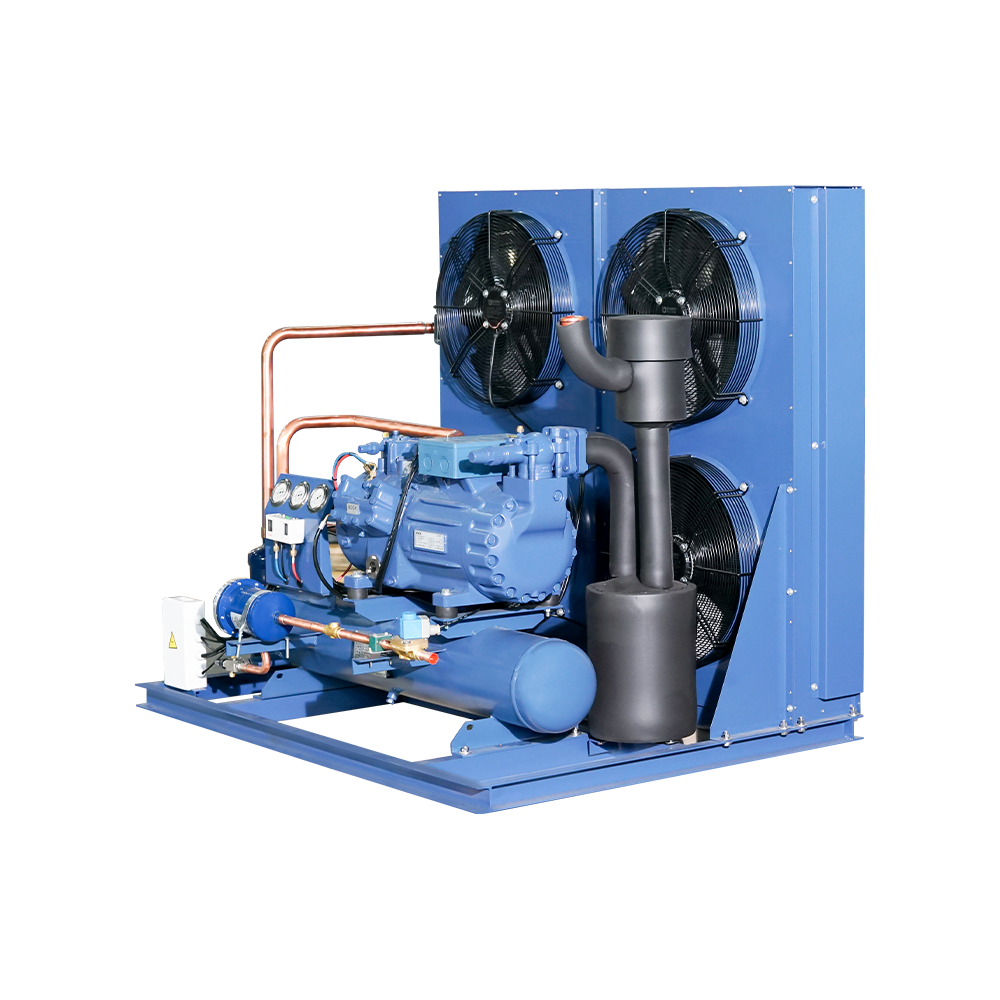
In commercial refrigeration — walk-in coolers, display cases, cold storage warehouses — the condensing unit serves the same fundamental purpose as in HVAC systems, but the demands are significantly different. Commercial refrigeration systems often run 24 hours a day, 365 days a year, with no off-season. The refrigerant temperatures involved are also much lower, since a walk-in freezer may need to maintain -10°F (-23°C) or colder.
Commercial condensing units are often installed remotely — on rooftops or in mechanical rooms — connected to display cases or cold rooms by long refrigerant line runs. In supermarkets, a single large condensing unit or condensing unit rack may serve dozens of display cases simultaneously. These rack systems can contain four to twelve compressors operating in parallel, with individual compressors cycling on and off as refrigeration load varies throughout the day.
Energy consumption in commercial refrigeration is substantial. A medium-sized supermarket may spend $200,000 or more per year on electricity, with refrigeration accounting for 40–60% of that total. This is why commercial operators invest heavily in high-efficiency condensing unit technologies, including variable-speed compressors, electronically commutated fan motors, and advanced head pressure controls that optimize condensing temperature based on ambient conditions.
When to Repair vs. Replace a Condensing Unit
This is one of the most practical questions homeowners and facility managers face. There is no single universal answer, but several factors guide the decision reliably.
- Age of the unit: If the condensing unit is over 12–15 years old and requires a major repair (compressor, coil replacement), replacement is usually the better investment, since the remaining components are also aging and likely to fail soon.
- The 50% rule: If the repair cost exceeds 50% of the cost of a new unit, replacement typically makes more economic sense — especially when factoring in the efficiency gains of modern high-SEER equipment.
- Refrigerant type: Units using R-22 refrigerant cannot simply be recharged — R-22 production was banned in 2020, and remaining supplies are expensive. A unit requiring a major R-22 recharge is almost always a strong replacement candidate.
- Frequency of repairs: A condensing unit that has needed multiple service calls in a single season is a unit nearing the end of its practical service life, regardless of its age.
- Minor, isolated failures: A failed capacitor on a 6-year-old unit, a bent fin that can be combed straight, or a dirty coil that needs cleaning — these are repairs that make full sense on a relatively young, otherwise healthy condensing unit.
Upgrading from a 10 SEER condensing unit to a 20 SEER model can cut cooling electricity costs by approximately 50%. In a climate like Los Angeles or Phoenix where air conditioning runs heavily from May through October, that efficiency gain translates to real savings that can partially offset the cost of the new equipment over its lifespan.