

 English
 中文简体
中文简体Content
- 1 Is a Condensing Unit the Same as a Compressor? The Direct Answer
- 2 What Is a Condensing Unit and What Does It Contain?
- 3 What Is a Compressor and How Does It Work Independently?
- 4 Side-by-Side Comparison: Condensing Unit vs. Compressor
- 5 Where Condensing Units Are Used in Real Applications
- 6 When to Replace the Full Condensing Unit vs. Just the Compressor
- 7 How Condensing Unit Capacity Is Measured and Selected
- 8 Common Types of Condensing Units You'll Encounter
- 9 Refrigerant Choices and Their Effect on Condensing Unit Selection
- 10 Maintenance Practices That Extend Condensing Unit and Compressor Life
- 11 How to Read a Condensing Unit Nameplate and Specification Sheet
Is a Condensing Unit the Same as a Compressor? The Direct Answer
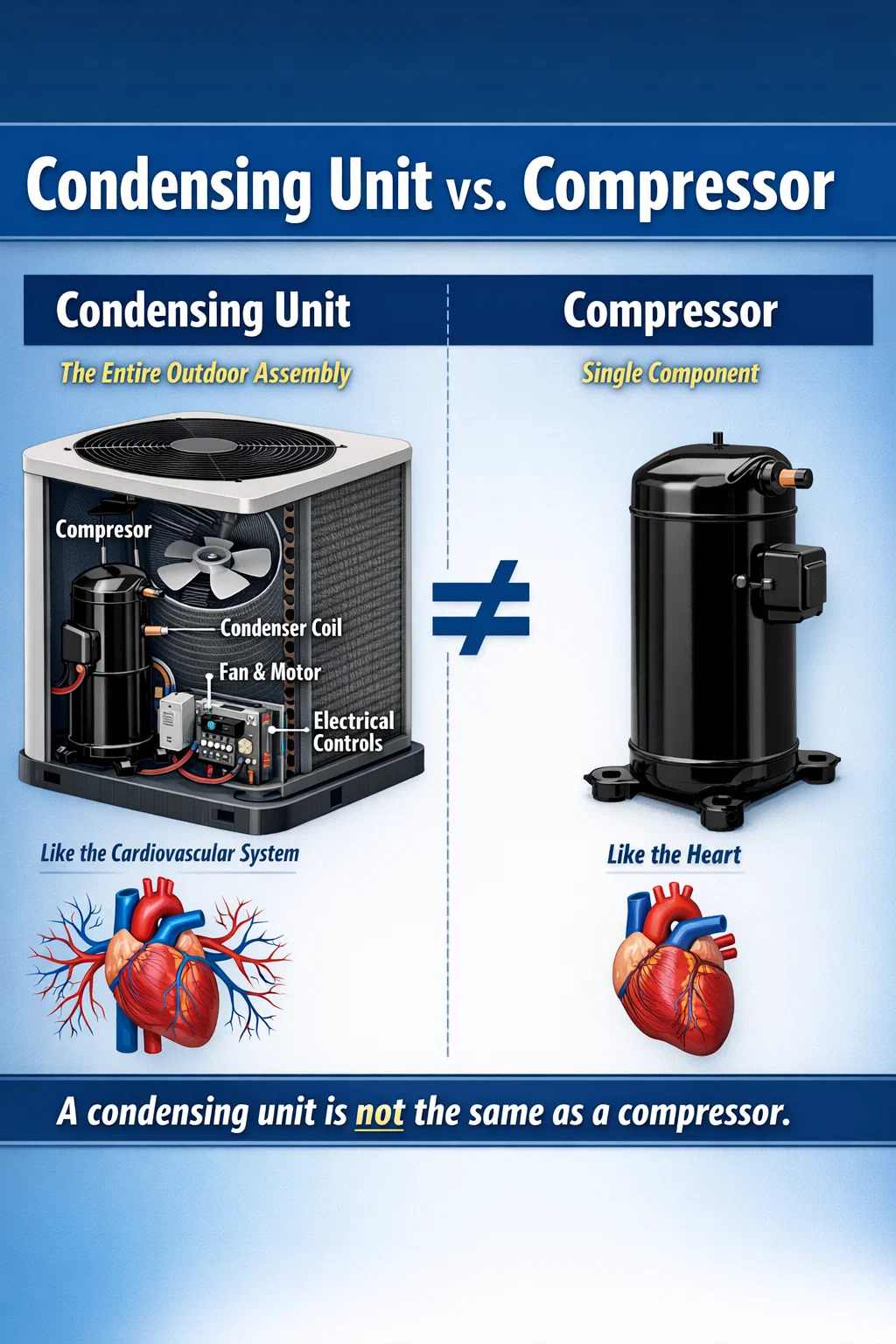
No, a condensing unit is not the same as a compressor. This is one of the most common points of confusion among homeowners, procurement managers, and even entry-level HVAC technicians. The compressor is a single mechanical component that pressurizes refrigerant gas. A condensing unit, by contrast, is a complete subassembly that includes the compressor, a condenser coil, a condenser fan motor, and all the interconnecting piping and electrical controls housed in one outdoor cabinet. Think of the compressor as the heart, and the condensing unit as the entire cardiovascular system — the heart cannot do its job without the arteries, veins, and valves surrounding it.
In practical terms, when a refrigeration or air conditioning technician orders a "condensing unit," they are ordering a ready-to-connect outdoor assembly. When they order a "compressor," they are ordering a single pump-like device that needs to be integrated into a larger system. The price gap reflects this difference: a standalone compressor for a mid-size commercial refrigeration application might cost between $200 and $800, while a matched condensing unit for the same application can run from $1,200 to over $5,000 depending on capacity and refrigerant type.
What Is a Condensing Unit and What Does It Contain?
A condensing unit is the outdoor portion of a split-system refrigeration or air conditioning setup. Its primary job is to take high-pressure, high-temperature refrigerant vapor that has absorbed heat from the indoor space, reject that heat into the ambient air, and send the now-liquid refrigerant back inside to repeat the cycle. It performs this task through several components working in coordination:
- Compressor: Draws in low-pressure refrigerant vapor from the evaporator side and compresses it to a high-pressure, high-temperature state. This is the only component shared in name with the standalone device.
- Condenser coil: A finned tube heat exchanger through which the hot compressed gas travels. As ambient air is forced over the fins, the refrigerant releases its heat and transitions from a gas to a liquid. Coil surface area directly affects efficiency — larger coils allow lower condensing temperatures and better COP (coefficient of performance).
- Condenser fan and motor: Pulls or pushes outdoor air across the condenser coil. Fan blade diameter, RPM, and motor wattage are matched to the coil size and unit capacity. A typical 3-ton residential condensing unit uses a fan motor in the range of 1/4 to 1/3 horsepower.
- Refrigerant service valves: Allow technicians to isolate, evacuate, and recharge refrigerant without removing the entire unit.
- Electrical controls and contactor: The contactor switches power to the compressor and fan motor. Capacitors (run and start capacitors) help both motors start and run efficiently. Many modern units also include a high-pressure and low-pressure cutout switch for protection.
- Filter drier (on many commercial models): Removes moisture and particulates from the refrigerant circuit to prevent acid formation and compressor damage.
- Subcooling circuit (on some high-efficiency models): Provides additional cooling of the liquid refrigerant below its condensing temperature, improving system efficiency by 2–5%.
All of these components arrive pre-assembled, pre-wired, and often pre-charged with refrigerant (or at least leak-tested at the factory). This is why a condensing unit can be installed and commissioned far faster than a field-assembled refrigeration rack.
What Is a Compressor and How Does It Work Independently?
The compressor is a vapor pump. It receives low-pressure refrigerant gas from the suction line (coming from the evaporator) and discharges it as high-pressure gas into the discharge line leading to the condenser coil. Without compression, there would be no pressure differential to drive the refrigeration cycle. Everything else in the system — the condenser, the expansion device, the evaporator — depends on the compressor to establish and maintain operating pressures.
Several types of compressors are used in modern HVAC and refrigeration:
- Reciprocating (piston) compressors: Common in older residential systems and light commercial refrigeration. They use pistons driven by a crankshaft to compress refrigerant. Reliable and inexpensive but less efficient at partial load than scroll types.
- Scroll compressors: Two interlocking spiral-shaped scrolls compress gas as one orbits the other. They dominate the residential and light commercial condensing unit market today because they are quieter (operating sound levels of 68–72 dB vs. 76–82 dB for reciprocating equivalents), more efficient, and have fewer moving parts.
- Rotary compressors: Used primarily in small-capacity applications like room air conditioners and dehumidifiers. A rolling piston sweeps refrigerant against a blade to compress it.
- Screw compressors: Twin helical rotors mesh together to compress gas continuously. Found in large commercial condensing units and chillers from 20 tons upward. Extremely reliable in continuous-run industrial applications.
- Centrifugal compressors: Use high-speed impellers to accelerate refrigerant, converting velocity into pressure. Reserved for large-tonnage chiller applications — typically 200 tons and above.
- Variable-speed (inverter-driven) compressors: Increasingly standard in high-efficiency residential and commercial condensing units. By varying motor speed to match load, they can achieve SEER2 ratings above 20, compared to 14–16 for single-speed equivalents.
When you purchase a standalone compressor, you receive only this mechanical pump — the housing, the motor, the compression mechanism, the suction and discharge ports. You are responsible for sourcing and connecting every other component in the refrigeration circuit. This is appropriate when replacing a failed compressor inside an existing condensing unit, but it is not the right approach when building or replacing a full outdoor refrigeration assembly.
Side-by-Side Comparison: Condensing Unit vs. Compressor
The table below summarizes the most important practical differences between a condensing unit and a standalone compressor across several categories relevant to purchasing and installation decisions.
| Category | Condensing Unit | Standalone Compressor |
|---|---|---|
| What's included | Compressor, condenser coil, fan, controls, valves, cabinet | Compressor motor and compression mechanism only |
| Typical installation context | New system installation or full outdoor unit replacement | Component-level repair within an existing system |
| Price range (residential 3-ton) | $900 – $2,500+ | $150 – $600 |
| Installation time | 2 – 4 hours (split system swap) | 3 – 6 hours (requires recovery, brazing, evacuation) |
| Efficiency rating | Rated as a system (SEER2, EER2, COP) | No system-level efficiency rating; rated by volumetric efficiency |
| Warranty structure | 5 – 10 years parts; often requires registered installation | 1 – 5 years parts (OEM or aftermarket dependent) |
| Who typically buys it | HVAC contractors, facility managers, food service operators | HVAC/R technicians performing targeted repairs |
Where Condensing Units Are Used in Real Applications
Condensing units appear across a surprisingly wide range of applications. Understanding where and how they are deployed helps clarify their role versus that of a bare compressor.
Residential Air Conditioning
The most familiar example. A residential split-system air conditioner consists of an indoor air handler (with evaporator coil and blower) and an outdoor condensing unit. Standard residential condensing units range from 1.5 tons (18,000 BTU/hr) to 5 tons (60,000 BTU/hr). In the United States, federal minimum efficiency standards that took effect in January 2023 (SEER2 regulations) require most residential condensing units in the southern region to meet at least SEER2 14.3 for single-phase systems. High-efficiency models from brands like Carrier, Trane, Lennox, and Daikin reach SEER2 ratings of 20 to 24, significantly reducing operating costs for homeowners in hot climates.
Commercial Refrigeration
Supermarkets, convenience stores, restaurants, and cold storage warehouses rely heavily on commercial condensing units. In these applications, a single condensing unit may serve multiple evaporator coils inside walk-in coolers, display cases, or prep areas. Commercial condensing units for refrigeration are classified by the temperature range they serve:
- High-temperature (HT): Designed for cooler applications holding product at 35–55°F. Typical for produce, dairy, and beverage coolers.
- Medium-temperature (MT): For applications in the 0–35°F range, such as meat and seafood display cases.
- Low-temperature (LT): Freezer applications at -20°F to 0°F. These require compressors rated for low suction pressures and often use two-stage or compound compression.
A typical small restaurant might operate a 2–3 horsepower medium-temperature condensing unit serving a walk-in cooler and a 1.5–2 horsepower low-temperature unit for a reach-in freezer.
Industrial Process Cooling
Manufacturing processes that generate heat — injection molding, laser cutting, data center cooling, brewery fermentation — often use process condensing units or remote condensing units integrated with water-cooled or glycol-cooled evaporators. These units can range from 1 ton to well over 100 tons of refrigeration capacity and may use refrigerants like R-448A, R-449A, or R-744 (CO₂) depending on environmental and efficiency requirements.
Transport Refrigeration
Refrigerated trucks and trailers use self-contained condensing units mounted on the front wall of the trailer. Brands like Thermo King and Carrier Transicold dominate this segment. These units must handle extreme ambient temperature swings (from -40°F in a Canadian winter to 115°F in a desert summer) while running reliably off diesel engine power or shore power.
When to Replace the Full Condensing Unit vs. Just the Compressor
This is one of the most consequential decisions a service technician or facility manager faces. The wrong choice wastes money either way — replacing the entire condensing unit when only the compressor was bad, or installing a new compressor into a failing system that will fail again in 18 months.
Replace Only the Compressor When:
- The system is less than 7 years old and the rest of the condensing unit components (coil, fan, controls) are in good condition.
- The compressor failed due to a one-time event like a lightning strike, refrigerant overcharge, or liquid slugging — not chronic issues.
- The system uses a refrigerant that is still widely available and not subject to imminent phase-out.
- The condenser coil passes a visual inspection — no significant fin damage, no evidence of leaks, clean airflow paths.
- Budget constraints are severe and the owner understands the calculated risk.
Replace the Entire Condensing Unit When:
- The system is 10 years or older. At this age, the cost of compressor replacement plus labor often approaches 50–70% of a new condensing unit price, without any improvement in reliability or efficiency.
- The compressor failed due to a "burnout" (electrical failure that contaminates the oil and refrigerant with acids). Replacing just the compressor after a burnout without flushing the entire system and replacing the filter drier almost guarantees a repeat failure within 1–2 years.
- The system uses R-22 or another phased-out refrigerant. R-22 was fully phased out of production in the US as of January 1, 2020. Reclaimed R-22 now sells for $40–$100 per pound, making it economically irrational to repair R-22 systems when modern refrigerant alternatives are available.
- The condenser coil shows significant corrosion, fin damage exceeding 25% of the coil face, or evidence of multiple brazed leak repairs.
- Energy costs are a priority — a new 16 SEER2 condensing unit can cut cooling energy consumption by 30–40% compared to a 10-year-old 10 SEER unit it replaces.
How Condensing Unit Capacity Is Measured and Selected
Selecting the right condensing unit capacity is not as simple as matching the horsepower of the old compressor. Condensing units are rated in tons of refrigeration (for air conditioning applications) or BTU/hr and horsepower (for commercial refrigeration). The selection must account for multiple variables:
- Design ambient temperature: A condensing unit rated at 3 tons at 95°F ambient may only deliver 2.5 tons at 110°F. In hot climates or rooftop installations, derate factors must be applied.
- Suction temperature (refrigeration applications): A commercial refrigeration condensing unit is rated at a specific saturated suction temperature (SST). A unit rated at 2 HP / -20°F SST is not directly comparable to one rated at 2 HP / 20°F SST — they serve fundamentally different temperature applications.
- Refrigerant type: The same compressor body running R-404A will produce significantly different capacity than when running R-448A or R-290 (propane). Always verify the condensing unit's published capacity is based on the refrigerant you intend to use.
- Line set length: Longer refrigerant piping between the condensing unit and the indoor evaporator increases pressure drop and reduces effective system capacity. For every additional 100 feet of line set beyond the rated length, expect a 1–3% capacity reduction depending on pipe size and refrigerant.
- Elevation: At high altitudes, lower air density reduces the condenser fan's ability to reject heat. Systems installed above 5,000 feet typically need to be upsized by 3–5%.
For residential air conditioning replacements, ACCA Manual S is the standard methodology for selecting condensing unit capacity to match a building's Manual J heat gain calculation. Oversizing a condensing unit by more than 15% causes short-cycling, poor humidity removal, and accelerated compressor wear — a common mistake made when contractors simply "go one size up."
Common Types of Condensing Units You'll Encounter
Not all condensing units look alike or are used interchangeably. The physical configuration, heat rejection method, and intended application vary significantly across product categories.
Air-Cooled Condensing Units
By far the most common type. The condenser coil rejects heat directly into outdoor air via a fan. They require no water source, minimal maintenance beyond coil cleaning, and are straightforward to install. The trade-off is reduced efficiency at high ambient temperatures. In a 100°F ambient, an air-cooled condensing unit operates at a condensing temperature around 120–130°F, which limits the pressure differential and reduces capacity.
Water-Cooled Condensing Units
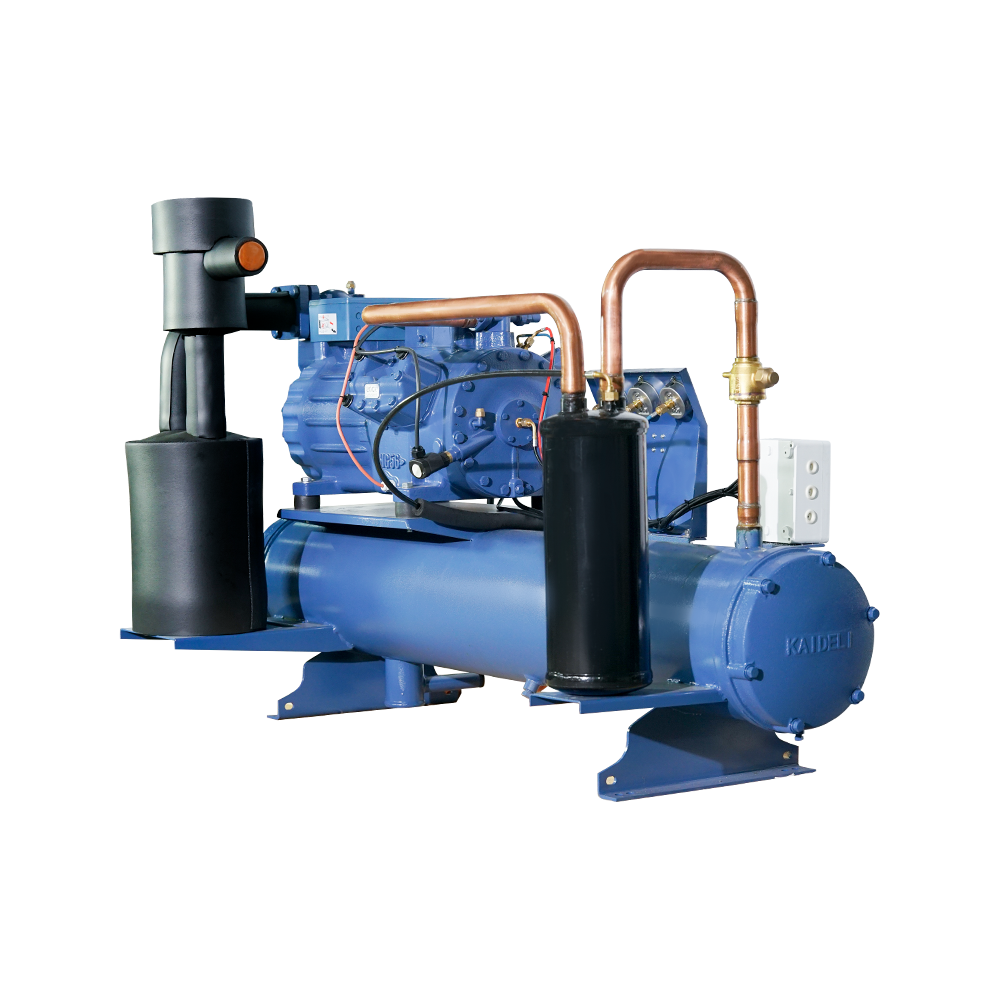
Use a water-cooled condenser (shell-and-tube or brazed plate heat exchanger) instead of an air-cooled coil. Because water temperature is far more stable than ambient air, water-cooled condensing units maintain more consistent operating pressures and typically achieve EER values 20–40% higher than air-cooled equivalents. They are common in indoor applications where ducting hot air outside is impractical. The downside is water consumption and the need for a cooling tower or chilled water loop.
Remote Condensing Units
Designed to be located away from the refrigerated space — typically on a rooftop or in a mechanical room — and connected to one or more evaporators via refrigerant piping. This configuration keeps compressor noise out of the sales floor or kitchen and allows centralized service access. Remote condensing units are standard in supermarket and food service design.
Hermetic vs. Semi-Hermetic Compressor-Based Condensing Units
Smaller condensing units (under approximately 5 HP) typically use hermetically sealed compressors, where the motor and compression mechanism share the same sealed housing. These are not field-serviceable — a failed hermetic compressor requires full replacement. Larger commercial condensing units often use semi-hermetic (serviceable) compressors, where the motor end can be separated and repaired in the field — replacing motor windings, valve plates, or connecting rods without replacing the entire compressor body. Semi-hermetic compressors for 10–25 HP commercial condensing units can cost $2,000–$6,000, making field serviceability economically meaningful.
Refrigerant Choices and Their Effect on Condensing Unit Selection
Refrigerant selection is increasingly a compliance and long-term cost issue, not just a performance issue. Condensing units are designed and charged for specific refrigerants — you cannot simply swap refrigerants in most cases without replacing the compressor, changing oil, and potentially replacing expansion devices and filter driers.
| Refrigerant | GWP | Primary Application | Status |
|---|---|---|---|
| R-22 | 1,810 | Legacy residential AC | Phased out (US 2020) |
| R-410A | 2,088 | Residential AC (dominant until 2025) | Being phased down (EPA Section 608) |
| R-32 | 675 | Residential AC, mini-splits | Growing adoption |
| R-454B | 466 | Next-gen residential AC condensing units | Rapidly expanding (Carrier Puron Advance, others) |
| R-448A / R-449A | ~1,300 | Commercial refrigeration condensing units | Current standard replacing R-404A |
| R-744 (CO₂) | 1 | Transcritical commercial refrigeration | Growing in supermarket applications |
When purchasing a replacement condensing unit today, verify the refrigerant it uses is not subject to near-term phase-down restrictions in your region. Buying a new R-410A condensing unit in 2024 or 2025 introduces risk that parts and refrigerant will become more expensive and harder to source within the system's expected 15–20 year service life.
Maintenance Practices That Extend Condensing Unit and Compressor Life
Most premature compressor failures inside condensing units are preventable. The compressor is the most expensive single component to replace, and nearly every failure mode has a root cause in a maintenance-related or installation-related factor.
Condenser Coil Cleaning
A dirty condenser coil raises condensing temperature, which increases compressor discharge temperature and pressure. Studies have shown that a condenser coil operating at just 10°F above its clean baseline can reduce compressor efficiency by 5–8% and reduce compressor life by increasing discharge temperatures beyond design limits. Annual coil cleaning with a coil cleaner and low-pressure rinse is non-negotiable for commercial units; twice-yearly cleaning is appropriate for units in dusty or cottonwood-heavy environments.
Refrigerant Charge Verification
Both overcharge and undercharge damage compressors. An undercharged system runs the compressor hot and can cause it to lose lubrication as oil circulates with insufficient refrigerant flow. An overcharged system risks liquid slugging — refrigerant liquid entering the compressor — which can bend connecting rods in reciprocating compressors or damage scroll wraps within seconds. Refrigerant charge should be verified against the manufacturer's subcooling or superheat specification, not estimated from gauges alone.
Electrical System Checks
Low voltage is one of the most common causes of compressor motor failure. A compressor motor designed for 208–230V operation that repeatedly starts at 195V due to a weak capacitor or low utility voltage will overheat motor windings over time. Technicians should measure actual voltage at the compressor terminals during startup — voltage must remain within ±10% of nameplate rating throughout the start cycle. Run capacitors should be tested with a capacitance meter and replaced if they measure more than 6% below their rated microfarad value.
Clearance and Airflow Around the Condensing Unit
Recirculation of hot discharge air back into the condenser fan inlet is a significant problem in poorly planned installations. Most manufacturers specify a minimum of 12–18 inches of clearance on the sides and 24–48 inches of unobstructed space above a top-discharge unit. Fences, shrubs, equipment, and adjacent buildings can all cause short-circuiting that raises ambient temperature at the coil by 10–20°F, with corresponding compressor stress. If a condensing unit is enclosed for aesthetic reasons, the enclosure must be engineered with sufficient free area for airflow — generally at least 75% open on the discharge side.
How to Read a Condensing Unit Nameplate and Specification Sheet
When you encounter a condensing unit in the field or are evaluating a specification sheet, knowing what the key data points mean is essential for making good decisions about replacement, repair, or system design.
- Model number: Most manufacturers encode the nominal cooling capacity in the model number. A Carrier 24ACC636 encodes "36" as 36,000 BTU/hr (3 tons). Trane, Lennox, and others use similar conventions but with different positional coding — always verify with the manufacturer's model nomenclature guide.
- RLA (Rated Load Amps): The expected current draw of the compressor motor at full load. Used to size circuit breakers, wiring, and disconnect switches. The MCA (Minimum Circuit Ampacity) and MOCP (Maximum Overcurrent Protection) values on the nameplate are the key numbers for electrical code compliance.
- Refrigerant and charge weight: The factory refrigerant charge is listed in ounces or pounds. This is the total system charge including the condensing unit's internal volume — the actual operating charge will differ based on line set length and evaporator volume, which is why most manufacturers provide a charge adjustment formula.
- High-pressure and low-pressure cutout settings: Protect the compressor from operating outside safe pressure limits. Knowing these values helps diagnose nuisance trips vs. genuine system problems.
- Sound rating (dB or Bels): Relevant for installations near bedrooms, offices, or property lines with noise ordinances. Premium condensing units achieve sound ratings of 68–72 dB(A) at 10 feet; budget models may be 76–80 dB(A) — a difference that is readily perceptible in residential settings.