

 English
 中文简体
Content
- 1 What "Compressor Refrigerant" Really Means
- 2 Refrigerant Properties That Drive Compressor Performance
- 3 Common Refrigerants and Their Compressor Applications
- 4 How to Select the Right Refrigerant for a Compressor System
- 5 Refrigerant and Compressor Oil Compatibility
- 6 Condensing Units: Where Compressor and Refrigerant Meet
- 7 Refrigerant Charging and Common Failure Signs
- 8 Frequently Asked Questions
- 8.1 Can I replace R-404A with R-449A in the same compressor?
- 8.2 What is the best refrigerant for cold storage compressors in 2026?
- 8.3 Why does high discharge temperature destroy compressors so quickly?
- 8.4 Does R-32 work in a compressor designed for R-410A?
- 8.5 What happens if the compressor oil is not miscible with the refrigerant?
- 8.6 How do I know if a condensing unit is correctly charged?
- 9 Practical Takeaways
A service technician once replaced R-404A with R-449A in a cold-room condensing unit but left the expansion valve charge untouched. Within two hours the discharge line reached 132°C, the crankcase oil sight glass flashed with refrigerant, and the high-pressure switch began cycling the compressor every few minutes. The room still cooled, but the compressor was operating outside every design limit on the OEM data sheet.
The lesson is direct: compressor refrigerant selection is an engineering decision, not a field adjustment. The refrigerant sets the pressure envelope, motor load, discharge temperature, oil return behavior, and long-term reliability of the compressor. Get it right and the compressor runs quietly for years; get it wrong and the failure is simply a matter of time.
This guide explains what links a compressor to its refrigerant, which refrigerant properties matter most, how to compare refrigerants for cold storage and condensing units, and the practical steps to guarantee a compatible match.
What "Compressor Refrigerant" Really Means
A vapor-compression circuit moves heat through the phase changes of a working fluid. Low-pressure liquid boils in the evaporator and removes heat from the room; the compressor draws that low-pressure vapor and raises it to a pressure and temperature high enough to reject heat in the condenser; the expansion device returns the liquid to the evaporator at the correct rate.
The compressor is therefore a vapor pump. It must always receive dry, slightly superheated gas that is free of liquid slugs and chemically stable at the discharge temperature. The refrigerant defines all these limits. When people talk about a "compressor refrigerant", they are really talking about the working fluid that the compressor is designed and approved to handle.
A compressor is approved for a refrigerant when its manufacturer has verified mechanical strength, motor cooling, lubrication, materials compatibility, valve dynamics, and capacity data at the operating conditions of that refrigerant. This approval is not a formality; it is the result of thousands of hours of testing under real operating envelopes.
Why refrigerant choice is becoming more complicated
- Twenty years ago, R-404A and R-22 covered most low-temperature and medium-temperature applications.
- In 2026, the market is split across R-448A, R-449A, R-454B, R-32, R-290, and several HFO blends.
- Each option has a different pressure curve, glide, flammability class, and discharge temperature behavior.
- The compressor decision now has to be made refrigerant-first, not compressor-first.
Refrigerant Properties That Drive Compressor Performance
Before comparing refrigerants, you need to understand which physical properties directly affect the compressor. The table below summarizes the connection.
| Property | Impact on the compressor |
|---|---|
| Saturation pressure | Sets shell design pressure, relief valve setting, and motor winding stress |
| Volumetric cooling capacity | Determines required displacement and motor size at the design temperature |
| Discharge temperature | Controls valve life, oil oxidation rate, and crankcase temperature |
| Temperature glide | Changes evaporator superheat control and expansion valve behavior |
| Oil miscibility | Affects oil return from the evaporator and crankcase oil level stability |
| GWP | Drives long-term refrigerant cost, availability, and replacement planning |
Discharge temperature is the fastest failure trigger
If suction pressure drops or the compression ratio rises, discharge temperature climbs with it. Sustained values above roughly 135°C speed up oil oxidation, carbonate discharge valves, and overheat motor windings in hermetic compressors. Most compressor OEM guidelines draw the continuous limit at 130-140°C. R-32 and several low-GWP blends run 10-15 K hotter than R-404A under the same conditions, which is why some compressor families require vapor injection or additional motor cooling before they accept these refrigerants.
Temperature glide changes the way you set superheat
Zeotropic blends such as R-407C, R-448A, and R-449A have a temperature glide of roughly 4-7 K. With glide, the evaporator inlet and outlet temperatures are not equal, and the bubble point differs from the dew point. An expansion valve tuned for an azeotrope will hunt on a glide refrigerant. For R-404A, with a glide below 1 K, superheat behaves almost like a single component. For R-449A, with a glide of 4-5 K, you must calculate superheat from the evaporating pressure using the dew point reference; otherwise the compressor runs hotter than the gauge suggests.
Common Refrigerants and Their Compressor Applications
The table below compares the refrigerants most frequently specified with compressors in commercial and industrial refrigeration in 2026.
| Refrigerant | Type | GWP (AR4) | Typical compressor application |
|---|---|---|---|
| R-134a | HFC | 1,430 | Semi-hermetic piston and scroll for medium-temperature cold rooms and chillers |
| R-404A | HFC blend | 3,922 | Existing low-temperature freezers and cold stores; rarely specified in new equipment |
| R-410A | HFC blend | 2,088 | Scroll compressors for air conditioning and heat pumps |
| R-32 | HFC | 675 | New scroll compressors for air conditioning; higher discharge temperature |
| R-454B | HFO/HFC blend | 466 | New scroll compressors for air conditioning as a lower-GWP replacement for R-410A |
| R-407C | HFC blend | 1,774 | Piston and scroll compressors for medium-temperature retrofits from R-22 |
| R-449A | HFO/HFC blend | ~1,400 | Piston, screw, and scroll compressors for medium and low-temperature refrigeration |
| R-448A | HFO/HFC blend | ~1,387 | Piston, screw, and scroll compressors for medium and low-temperature refrigeration |
| R-290 | Hydrocarbon | 3 | Small hermetic compressors in self-contained cold rooms and plug-in units |
| R-513A | HFO/HFC blend | 573 | Screw and piston compressors for medium-temperature chillers and condensing units |
Note: GWP values follow the IPCC Fourth Assessment Report (AR4) figures used in ASHRAE Standard 34; glide and classification data follow ASHRAE Standard 34 and refrigerant manufacturers' technical datasheets. Always verify against the latest OEM approved refrigerant list.
The direction of change in 2026
R-404A and R-507 are no longer a rational choice for new installations in most markets, mainly because of rising cost and shrinking availability. R-448A and R-449A deliver near-R-404A performance in cold storage and retail systems, with capacity differences usually within 5%. For air-conditioning scrolls, R-32 and R-454B have displaced R-410A in newly produced equipment. R-290 is spreading in small hermetically sealed cold rooms, where charge limits and A3 safety requirements are manageable at the factory level.
How to Select the Right Refrigerant for a Compressor System
Follow the heat load, not the old nameplate. The starting point is not "which refrigerant do I like" but "what must the system achieve". Use the following steps in order.
- Define the operating envelope. For a freezer room with a design air temperature of -25°C, choose an evaporating temperature of roughly -32°C to -35°C. For a +5°C cold room, choose about -10°C evaporating. Condensing temperature is normally 10-15 K above the summer ambient design temperature.
- Calculate the total cooling load. Include the room heat gain, product load, people and forklift traffic, evaporator fan heat, and defrost heat. The final number is your required capacity in kW.
- Select the refrigerant family. For medium and low-temperature commercial plants in 2026, R-449A or R-448A is the practical default; R-290 is chosen for small self-contained units; R-454B or R-32 is the air-conditioning scroll choice; R-134a or R-513A fits medium-temperature process cooling.
- Shortlist compressor models on the OEM approved refrigerant list. Do not choose a compressor that is not explicitly listed for that refrigerant.
- Verify capacity and motor power at your exact evaporating and condensing temperatures. Capacity is not transferable across refrigerants; always read the capacity table for the specific operating point.
- Check discharge temperature at the worst summer condition. If the calculated value exceeds the OEM limit, add liquid injection, vapor injection, or a larger condenser before finalizing the selection.
- Confirm the oil base and oil charge. A change from R-404A to R-449A keeps POE oil, but the required oil level and charge volume can differ.
- Review refrigerant availability and service support for the next five years. A cheap refrigerant with a weak supply chain will cost you far more in downtime.
Example: a 15 kW freezer room at -25°C with a +40°C condensing condition. A semi-hermetic piston compressor approved for R-449A will typically need a displacement within 3-5% of the R-404A selection, and the motor size usually stays the same. The expansion valve orifice, the liquid line filter core, and the superheat setting must be changed for the glide behavior. The optimal charge mass will differ from R-404A, so charge by weight and verify subcooling afterward.
For centralized industrial plants above roughly 40 kW, screw compressor condensing units provide smoother part-load control and lower vibration levels than reciprocating units, especially when the plant runs multi-temperature zones.
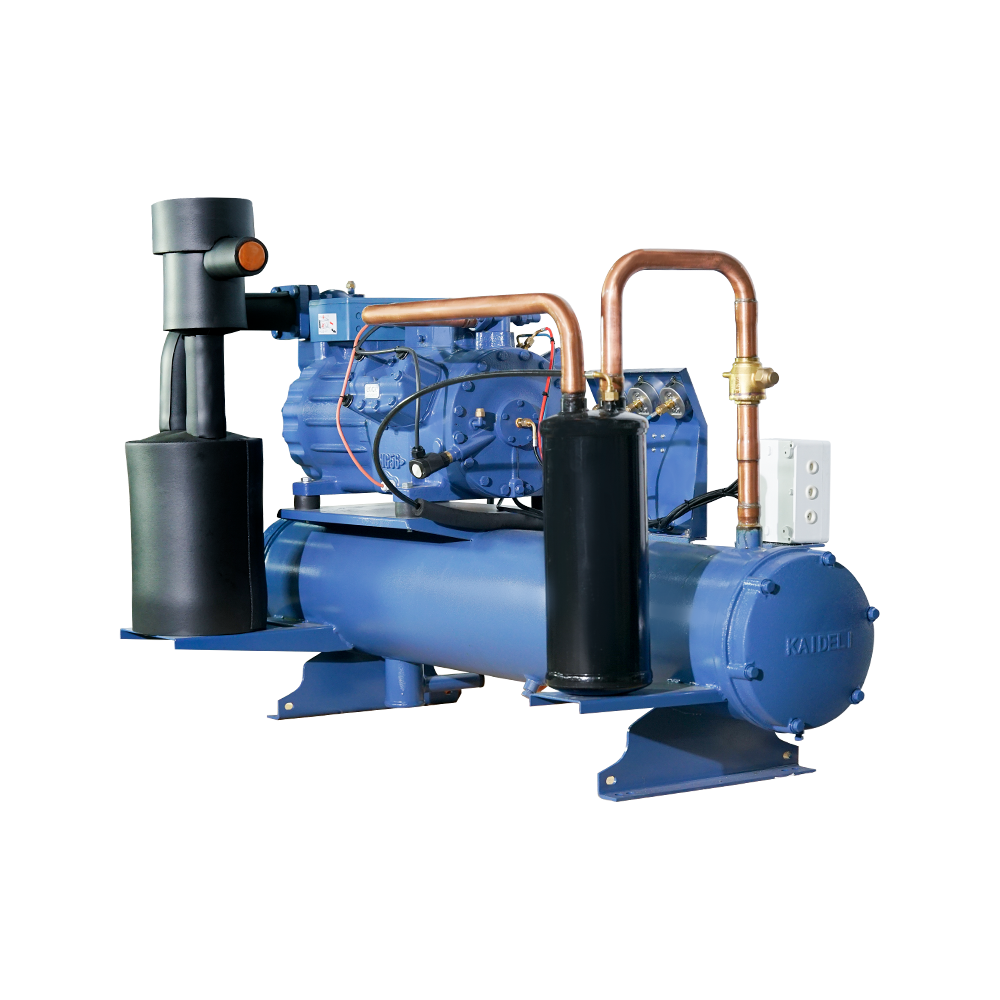
 KCS Series Screw Condensing Unit for Large-Scale CoolingThis screw condensing unit offers smooth part-load control and low vibration for centralized plants above 40 kW, with multi-stage energy regulation reducing annual power consumption by 15-20% and supporting multi-temperature zones.View Product →
Refrigerant and Compressor Oil Compatibility
The refrigerant and the oil operate as one mixture inside the compressor. They separate in the evaporator, return through the suction line, and are separated again in the crankcase. If they are not miscible, oil stays trapped where the refrigerant evaporates.
| Refrigerant family | Recommended oil | Why it works |
|---|---|---|
| R-22 (HCFC) | Mineral oil or alkylbenzene | Good miscibility and proven bearing protection at typical evaporating temperatures |
| R-134a, R-404A, R-410A (HFC) | POE (polyol ester) | HFCs have poor solubility in mineral oil; POE guarantees oil return and bearing protection |
| R-448A, R-449A, R-454B (HFO/HFC) | POE (polyol ester) | Same oil return logic as HFC, with confirmed stability at higher discharge temperatures |
| R-290 (hydrocarbon) | Mineral oil or POE per OEM approval | Oil choice follows compressor design; refrigerant charge and electrical approval matter more |
| Mobile AC systems | PAG (polyalkylene glycol) | Highly hygroscopic, used only in automotive compressor circuits, not in fixed refrigeration |
POE oil is aggressively hygroscopic. Every time a system is opened, moisture enters the POE and later forms acid in the presence of heat and refrigerant. That is why the service procedure is always the same: break the vacuum with dry nitrogen, evacuate below 500 microns, and replace the filter drier whenever the circuit is opened.
Condensing Units: Where Compressor and Refrigerant Meet
A condensing unit packages the compressor, condenser, receiver, fan, and controls into one factory-tested module. The compressor refrigerant connection is already matched: the circuit has been charged with the correct mass, the oil level is set, the pressure switches are calibrated, and the performance is documented.
Open-type condensing units separate the compressor from the drive motor. Because the motor is cooled by ambient air, the compressor receives less motor heat. These units are common in medium and low-temperature cold stores where service access is important and where larger or refrigeration-specific motors are required. They also allow easier compressor replacement without discarding the whole circuit. You can see the main construction differences in our overview of open-type compressor condensing units.
 KCFP Series Open Type Condensing Unit with External MotorSuitable for medium and low-temperature cold stores, this open-type unit separates the compressor from the motor for easier service and compressor replacement, factory-tested for R-404A and R-448A/R-449A systems.View Product →
For the operator, the practical gain is the removal of guesswork. The supplier has already tested the refrigerant charge, oil volume, and operating pressure range. Kaidi's condensing units are delivered as complete packages for the R-404A and R-448A/R-449A families, with a factory-tested performance report, so the refrigerant circuit arrives with the compressor and condenser designed as one system.
Refrigerant Charging and Common Failure Signs
Three practices separate a long-lived compressor from an early one: charging discipline, superheat control, and commissioning records.
Charging discipline
- Charge by weight. Put the required mass on a calibrated scale and fill the liquid line with liquid refrigerant.
- Charge zeotropic blends through the liquid port. A glide blend fractionates in the vapor phase, so never charge it as vapor from the top of the cylinder.
- Evacuate the whole circuit to below 500 microns before charging. This is the only reliable way to remove moisture and non-condensables that inflate discharge pressure.
- Never mix refrigerants. A system charged with a mix of R-22 and R-449A develops high discharge temperatures, unstable glide behavior, and unpredictable oil return.
Superheat as a compressor guard
For direct expansion systems with thermostatic expansion valves, a typical evaporator superheat setting is 5-8 K at the evaporator outlet. Too low and liquid floods the compressor; too high and discharge temperature climbs. For glide blends, use the dew-point pressure at the evaporator to calculate superheat.
| Symptom | Likely cause | First check |
|---|---|---|
| High discharge temperature | Low suction pressure, high compression ratio, low charge, dirty condenser | Suction superheat, condensing pressure, condenser delta T |
| Liquid slugging at start-up | Flooded evaporator, overcharge, failed crankcase heater | Superheat, receiver level, crankcase oil level |
| Rapid short cycling | Pressure switch differential too narrow, TXV hunting, solenoid leak-by | Switch setting, TXV stability, solenoid seat |
| Oil foaming in sight glass | Refrigerant migrating into the crankcase during off-cycle | Crankcase heater, pump-down cycle |
| Loss of cooling capacity | Wrong charge, mismatched expansion device, blocked coils | Subcooling, superheat, coil cleanliness |
These checks follow standard refrigeration service practice. Always align the final settings with the compressor OEM's commissioning sheet for the specific refrigerant in use.
Frequently Asked Questions
Can I replace R-404A with R-449A in the same compressor?
Sometimes, but not as a straight drop-in. The compressor must be on the OEM approved list for R-449A, the TXV nozzle must be changed for the different liquid density and glide, the superheat must be reset, and pressure switches should be verified. Capacity will be close in most conditions, but discharge temperature will differ by a few Kelvin. If the system uses a fixed orifice, replace the orifice; never tune the system by adding extra charge.
What is the best refrigerant for cold storage compressors in 2026?
For new medium and low-temperature cold stores in most markets, R-449A and R-448A are the practical first choice because they fit existing compressor frames within roughly 5% capacity and circulate with POE oil. For small plug-in cold rooms, R-290 is growing quickly because its GWP is only 3, efficiency is good, and the flammable charge stays within the limits that equipment manufacturers can manage at the factory.
Why does high discharge temperature destroy compressors so quickly?
Oil oxidation accelerates significantly with every 10 K rise in temperature. Sustained discharge temperatures above roughly 135°C carbonize the oil on valves, degrade the clearance volume, and in hermetic compressors, reduce motor winding protection. The valve seats erode, oil viscosity drops, and the compressor begins to lose volumetric efficiency until it eventually fails.
Does R-32 work in a compressor designed for R-410A?
No, not without OEM approval. R-32 produces a higher discharge temperature and has a different pressure curve. The compressor needs a dedicated design with enhanced motor cooling and a wider operating envelope. Simply changing the refrigerant in an R-410A scroll without approval raises the risk of overheating, and the published performance data no longer applies.
What happens if the compressor oil is not miscible with the refrigerant?
The oil separates and stays in the evaporator. The crankcase oil level drops, bearings starve, and the suction line carries oil slugs back to the compressor. The result is scored crankshafts, damaged valves, and high oil consumption. Use exactly the oil base specified by the compressor OEM for the refrigerant in the system.
How do I know if a condensing unit is correctly charged?
Calculate subcooling at the condenser outlet, check the sight glass for a solid liquid stream, and compare the charge to the unit's test report. On a new installation, record pressures, superheat, subcooling, and ambient temperature after commissioning. Use those values later as the baseline for any service call.
Practical Takeaways
- Treat the compressor and refrigerant as one engineered system, not two separate parts.
- Choose the refrigerant first from the shortlist that will actually be serviceable in your region for the next five years, then select a compressor from the OEM approved list.
- Prefer factory-matched condensing units when possible; they remove the most common commissioning errors.
- Never mix refrigerants, never charge by pressure alone, and reset superheat when switching to a blend with glide.
- Keep a commissioning record of charge mass, subcooling, superheat, and discharge temperature for every unit.
For smaller commercial rooms with limited machine space, V-type box condensing units combine a compact footprint with reliable compressor refrigerant matching for medium and low-temperature cold rooms.
 KCFV1P Series V Type Box Type Condensing UnitDesigned for smaller commercial cold rooms with limited space, this compact V-type unit integrates a compressor and condenser in a box, featuring a V-shaped air duct that boosts heat exchange efficiency by over 15% and supports multiple refrigerants.View Product →
Kaidi engineers match compressors, condensing units, and refrigerants to real cooling loads every day. Tell us your room volume, designed air temperature, ambient temperature, and heat load, and the team will return a compressor refrigerant recommendation with a packaged condensing unit proposal. Contact us through the contact page or your regional distributor.