An air-cooled chiller is a central air conditioning unit that uses ambient air as the cold source and water as the cooling medium. This type of unit uses fans to drive air across the condenser, directly removing heat generated by the refrigeration system to produce chilled water. It can meet the year-round cooling demands of buildings or various industrial processes and is widely used in numerous fields due to its simple system structure and flexible installation.
Air-cooled chillers do not require cooling towers, cooling water pumps, or complex cooling water piping systems. They can be installed directly on rooftops, ground-level spaces, or other outdoor areas, saving machinery room space and auxiliary system investment. By using different secondary coolants (e.g., glycol solutions), some units can also provide low-temperature chilled water for process requirements, meeting a broader range of industrial cooling needs.
Zhejiang Kaidi Refrigeration Equipment Co., Ltd. has been deeply engaged in the refrigeration field for nearly thirty years. Based on a profound understanding of market demands, our developed and manufactured air-cooled chillers balance high efficiency, energy savings, stability, and reliability. Our products serve leading enterprises across multiple industries such as cold chain logistics, food processing, and data centers. Through professional technical solution design, we ensure each air-cooled chiller performs optimally in practical applications.
Working Principle and Core Components
The core working principle of an air-cooled chiller is the vapor-compression refrigeration cycle. The unit continuously transfers heat from building interiors or industrial processes to the outdoor air through the coordinated operation of four main components.
-
Evaporator: Acting as the system's heat absorption end, liquid refrigerant here absorbs heat from the water flowing through the evaporator's copper tubes, boiling and evaporating into a low-temperature, low-pressure gas, thereby producing chilled water.
-
Compressor: Serving as the system's "heart," it draws in low-temperature, low-pressure refrigerant gas and compresses it into a high-temperature, high-pressure gas, creating the conditions for heat release. Common compressor types include screw compressors known for smooth operation and long service life, and scroll compressors valued for their compact structure and lower noise.
-
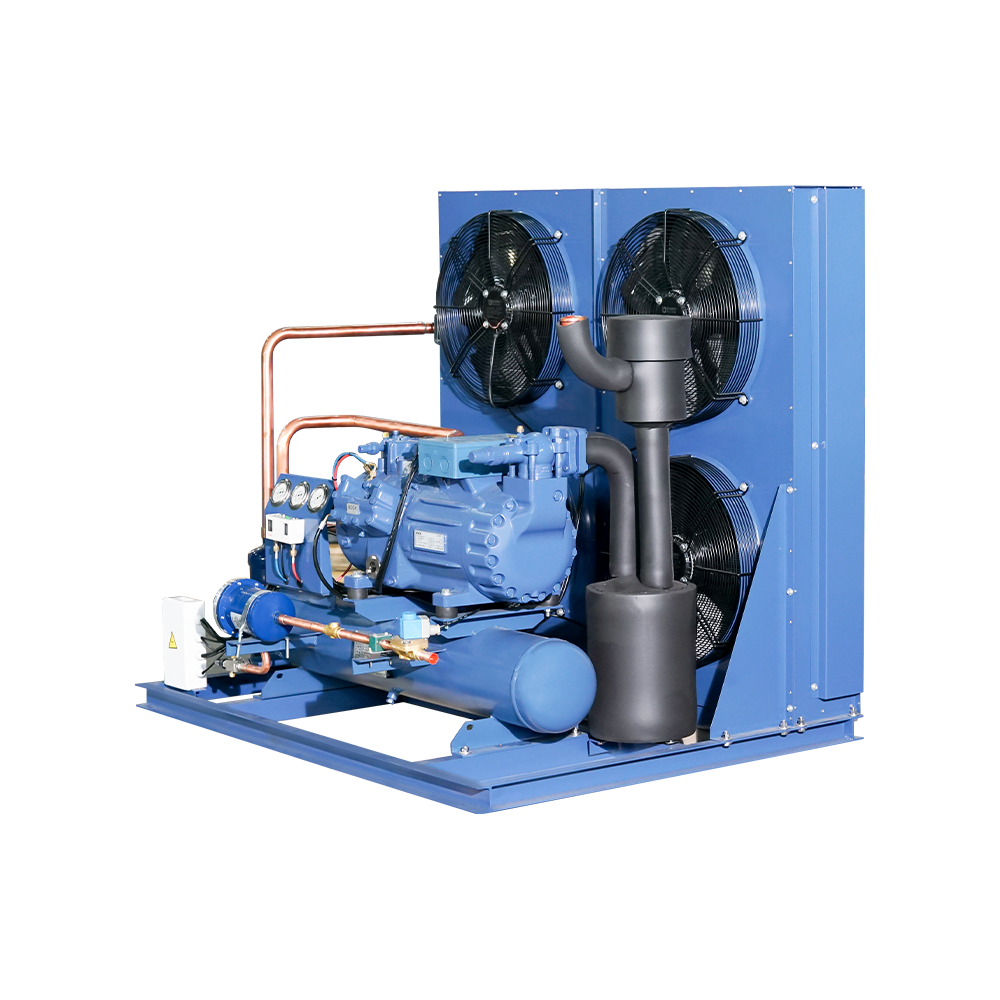
Condenser (Air-Cooled): This is the key component that distinguishes air-cooled from water-cooled chillers. High-temperature, high-pressure refrigerant gas flows here, where the unit's axial fans force ambient air over the condenser's finned tubes, dissipating the heat carried by the refrigerant into the atmosphere. The refrigerant then condenses into a high-pressure liquid.
-
Expansion Device (e.g., Electronic Expansion Valve): High-pressure liquid refrigerant passing through this point is throttled and depressurized, turning back into a low-temperature, low-pressure gas-liquid mixture, preparing it to re-enter the evaporator and absorb heat again. Advanced electronic expansion valves can precisely control flow, improving efficiency under partial load conditions.
To ensure long-term stable system operation, Zhejiang Kaidi Refrigeration continuously implements technological innovations in key components. For example, our products utilize a specially designed asymmetrical evaporator structure that creates more uniform refrigerant flow, enhancing heat exchange and oil return efficiency. Addressing the issue of condensers being prone to frost in low-temperature, high-humidity environments, our independently developed hot-gas defrosting technology uses built-in hot-gas pipes for efficient defrosting. This minimizes downtime and energy loss caused by defrost cycles, ensuring the unit's operational efficiency and performance.
Air-Cooled vs. Water-Cooled Chillers
When selecting a chiller, air-cooled and water-cooled are the two primary cooling methods. Their fundamental difference lies in where the final heat is rejected: air-cooled units use air, while water-cooled units use water. The table below clearly compares their main differences, serving as an important basis for initial project selection.
Zhejiang Kaidi Refrigeration believes there is no absolute "better" or "worse," only what is suitable. Our professional pre-sales team provides objective and neutral solution comparisons based on project cooling load requirements, geographic location, water resource conditions, initial investment budget, and long-term operating cost goals, helping clients choose the most suitable air-cooled chiller or other refrigeration solutions.
Main Types and Application Scenarios
Based on different compressors and functions, air-cooled chillers mainly fall into the following types, serving different market segments:
-
Air-Cooled Scroll Chiller/Heat Pump Units: Utilize hermetic scroll compressors, with a cooling capacity typically ranging from 45kW to 332kW. These units can not only provide chilled water but can also switch to heating mode (i.e., heat pump mode) via a four-way valve. They can even be paired with a heat recovery system to produce free hot water simultaneously while cooling, achieving multiple functions with one unit. They are widely used in comfort air conditioning systems for small to medium-sized office buildings, shopping malls, hospitals, schools, etc.
-
Air-Cooled Screw Chiller Units: Utilize semi-hermetic twin-screw compressors, offering larger single-unit cooling capacity, ranging from 287kW up to 1500kW. Screw compressors operate smoothly with long service life. Through variable frequency drive (VFD) technology, they can achieve stepless cooling capacity adjustment from 20% to 100%, with excellent part-load energy efficiency. These units are ideal for high-load, long-duration operation, commonly found in large data centers, district cooling plants, industrial plants, and process cooling applications.
-
Air-Cooled Chillers with Free Cooling Function: During cold or transitional seasons when the outdoor temperature is lower than the return water temperature, this system can partially or completely stop compressor operation, utilizing only cold air to exchange heat with the cooling water, significantly reducing energy consumption. This has substantial energy-saving significance for scenarios requiring year-round cooling, such as data centers and communication base stations.
Zhejiang Kaidi Refrigeration's product line covers the main types mentioned above. For instance, we supplied multiple high-efficiency air-cooled scroll heat pump units for a large central kitchen project in the Yangtze River Delta region. This not only met the round-the-clock temperature control needs of its processing workshops and cold storage rooms but also provided a significant amount of hot water for utensil cleaning through the heat recovery function, markedly reducing operating costs. This ability to deeply understand client processes and provide integrated solutions reflects our value as a "total solution provider."
Maintenance, Care, and Troubleshooting
Regular preventive maintenance is key to ensuring the efficient, stable, and long-lasting operation of an air-cooled chiller. A systematic maintenance plan should include the following core tasks:
Daily and Periodic Maintenance Points
-
Condenser Cleaning: Regularly inspect and clean the condenser aluminum fins to prevent clogging of air passages by catkins, dust, etc. This is the most important task for maintaining heat exchange efficiency.
-
Fan System Inspection: Check the lubrication of fan motor bearings, clean fan blades, and ensure fasteners are tight and operation is smooth without abnormal noise.
-
Refrigeration System Check: Observe refrigerant moisture (green indicator is normal) and charge level through the sight glass. Check pipelines for oil stains (which may indicate leaks).
-
Water System Check: Check chilled water quality. Regularly clean water filters to ensure evaporator water circuits are clear, without scaling or blockage.
-
Electrical and Control Check: Check tightness of main power and control line connections. Clean control cabinet dust. Verify accuracy of sensor readings.
Common Alarms and Fault Diagnosis
When the unit control system issues an alarm, preliminary diagnosis can be made following these guidelines:
Zhejiang Kaidi Refrigeration has established a full-cycle guarantee system from solution design to after-sales service. Our after-sales service team can not only respond quickly when faults occur but also provide regular preventive maintenance services. Utilizing professional testing tools and experience, we identify and eliminate potential risks in advance, ensuring clients' air-cooled chillers always operate in optimal condition.
Frequently Asked Questions
Q1: Can air-cooled chillers operate in low-temperature winter environments?
Yes. Standard air-cooled chillers are capable of operating in low-temperature environments. For locations requiring heating in winter, air-cooled heat pump units can be selected. These can switch between cooling and heating modes via system reversal. In severely cold regions, additional anti-freeze measures may be necessary, such as adding anti-freeze to the water system or selecting specialized units designed for lower ambient temperature operation.
Q2: The unit operates with high noise. How can this be resolved?
Noise may originate from the fan, compressor, or vibration. First, check if the installation is level and inspect for abnormal vibration at compressor mounts and pipelines. Fan noise may be related to bearing wear or blade dynamic imbalance. Zhejiang Kaidi Refrigeration emphasizes noise reduction during the product design phase, such as selecting low-noise scroll compressors, high-efficiency external rotor fans, and optimizing airflow design. For already installed units, improvement can be achieved by adding acoustic enclosures or setting up sound barriers.
Q3: How to determine if the unit's refrigerant needs replenishment?
If phenomena such as continuously declining cooling effect, abnormally low compressor suction pressure, or continuous bubbles in the sight glass occur, it may indicate insufficient refrigerant or a leak. In this case, refrigerant should not be added directly. Instead, a professional should first perform systematic leak detection using a leak detector. Refrigerant should be replenished quantitatively only after the leak point is repaired. Adding refrigerant blindly cannot solve the problem and may damage the compressor.
Q4: When selecting an air-cooled chiller, what core parameters besides cooling capacity should be considered?
-
Energy Efficiency Ratio: Check the unit's COP (Coefficient of Performance) or IPLV (Integrated Part Load Value). Higher values indicate greater energy efficiency.
-
Operating Range: Confirm that the unit's designed maximum and minimum ambient operating temperatures suit the local climate conditions.
-
Noise Level: Check the sound pressure level indicated on the product nameplate or datasheet to assess impact on the installation site and surrounding environment.
-
Intelligent Control: Advanced microprocessor control systems enable precise temperature control, fault alarms, network management, and other functions, enhancing ease of use and safety.



 English
 中文简体
中文简体







 23 Mar,2026