

 English
 中文简体
中文简体Content
- 1 The Core Function of an Evaporator in a Vapor-Compression Cycle
- 2 Key Working Principles: Heat Absorption, Pressure Drop, and Superheat
- 3 Different Types of Evaporators and Their Applications
- 4 Selecting an Evaporator: Key Parameters and Common Pitfalls
- 5 Evaporator Capacity Calculation: A Practical Example
- 6 Operation, Maintenance, and Troubleshooting
- 7 FAQ
- 7.1 What is the main function of an evaporator in a refrigeration system?
- 7.2 Why does evaporator pressure matter?
- 7.3 What is superheat and why is it important?
- 7.4 How do I choose the right evaporator for my cold room?
- 7.5 How often should I defrost an evaporator?
- 7.6 Can an evaporator work with different refrigerants?
- 7.7 What causes an evaporator to freeze up?
- 8 Conclusion
In a refrigeration system, the evaporator is the component that creates the cold. It absorbs heat from the target space or product and transfers it into refrigerant at low pressure and low temperature. Every other part of the cycle exists to make this heat absorption efficient and repeatable. This guide explains what an evaporator actually does, why its performance directly affects energy consumption and reliability, and how to choose and maintain one for a commercial or industrial cold chain application.
The Core Function of an Evaporator in a Vapor-Compression Cycle
The evaporator's primary function is to absorb heat into the refrigerant at low pressure, causing the refrigerant to boil and evaporate. In a vapor-compression system, refrigerant leaves the expansion valve as a low-pressure liquid-vapor mixture. It enters the evaporator, where warm air from the cooled space passes over the coil. The refrigerant absorbs that heat, changes phase from liquid to gas, and exits as a low-temperature vapor.
This phase change is what produces the cooling effect. When liquid refrigerant evaporates, it takes in latent heat from the surrounding air. The air loses energy and its temperature drops. Without the evaporator, the refrigeration cycle would have no way to transfer heat from the cold space into the refrigerant. The condenser and compressor are necessary, but they only move that heat out after the evaporator has collected it.
In a typical commercial cold room operating at an evaporating temperature of -25°C with R404A, the evaporator must handle both sensible heat (from air and product) and latent heat (from moisture condensation or freezing). Industry design data suggests that for a well-insulated cold room, the evaporator load can be roughly 15-20 kW per 100 m² of floor area for a 0°C application, and around 25-30 kW per 100 m² for a -25°C freezer, depending on product throughput and door openings.
Key Working Principles: Heat Absorption, Pressure Drop, and Superheat
The evaporator works at low pressure, so the refrigerant boils at a low temperature. The expansion valve or electronic expansion valve (EEV) reduces the refrigerant pressure, which lowers its boiling point. As the refrigerant travels through the evaporator coil, it absorbs heat and gradually turns into vapor. The temperature of the refrigerant remains nearly constant during this phase change, but the air temperature decreases.
Why Pressure Drop Matters
The evaporator is not just a simple heat exchanger. It also introduces a pressure drop as refrigerant flows through the tubes and bends. Every 1 bar of pressure drop reduces the effective temperature difference between refrigerant and air, which lowers capacity. A poorly designed evaporator can lose up to 5-10% of its nominal capacity just from internal pressure loss. This is why manufacturers specify maximum allowable pressure drops for their coils and why the connecting piping between the expansion valve and evaporator must be adequately sized.
Superheat and Compressor Safety
Superheat is the difference between the refrigerant temperature at the evaporator outlet and its saturation temperature at that pressure. A typical design target is 5-10 K of superheat. The superheat ensures that all liquid refrigerant has been vaporized, preventing liquid slugging from entering the compressor. If the evaporator is sized too large, the superheat may be too low, and liquid refrigerant can return to the compressor and damage its valves. If the evaporator is undersized, the superheat may be too high, leading to reduced system capacity and elevated discharge temperatures.
Different Types of Evaporators and Their Applications
Evaporators are classified by their airflow arrangement, mounting style, and refrigerant feed method. The choice of evaporator type directly affects how evenly the cold air is distributed, how ice is handled, and how much energy is needed to maintain the required temperature.
Ceiling-Mounted Air Coolers for Commercial Cold Storage
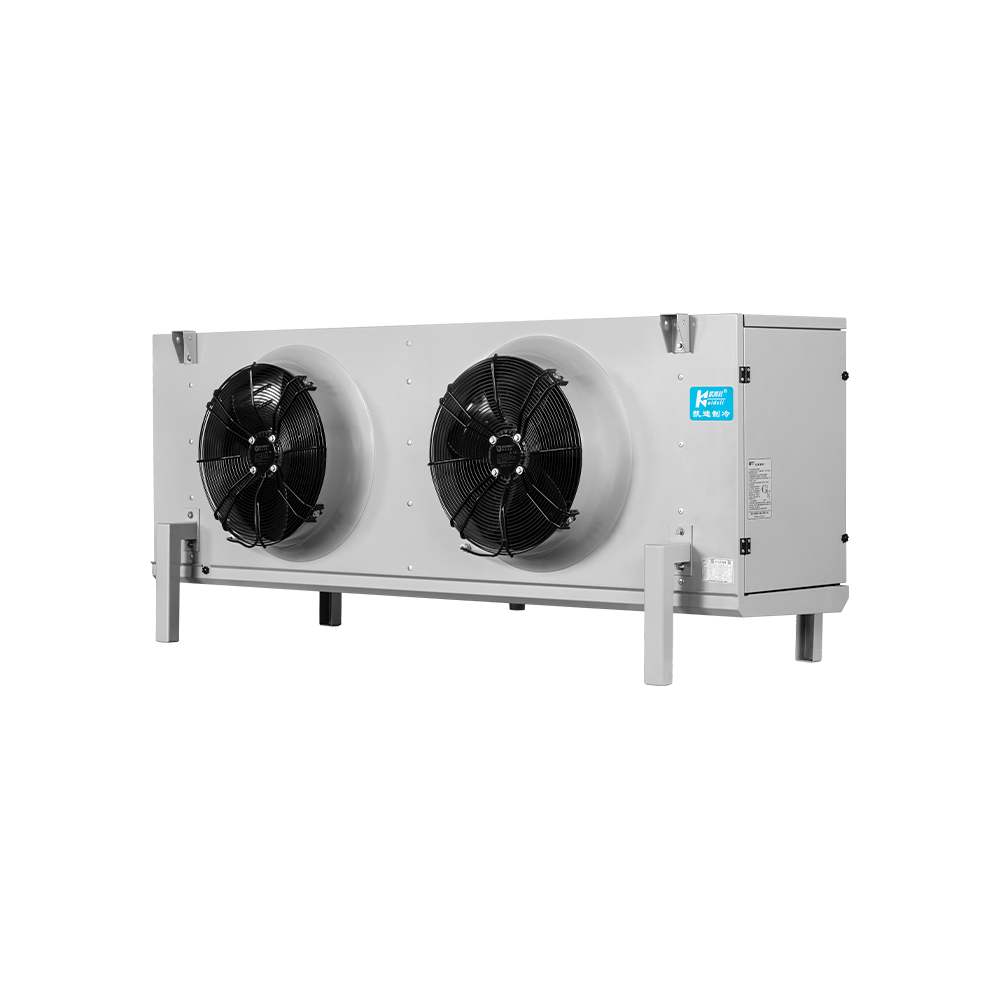
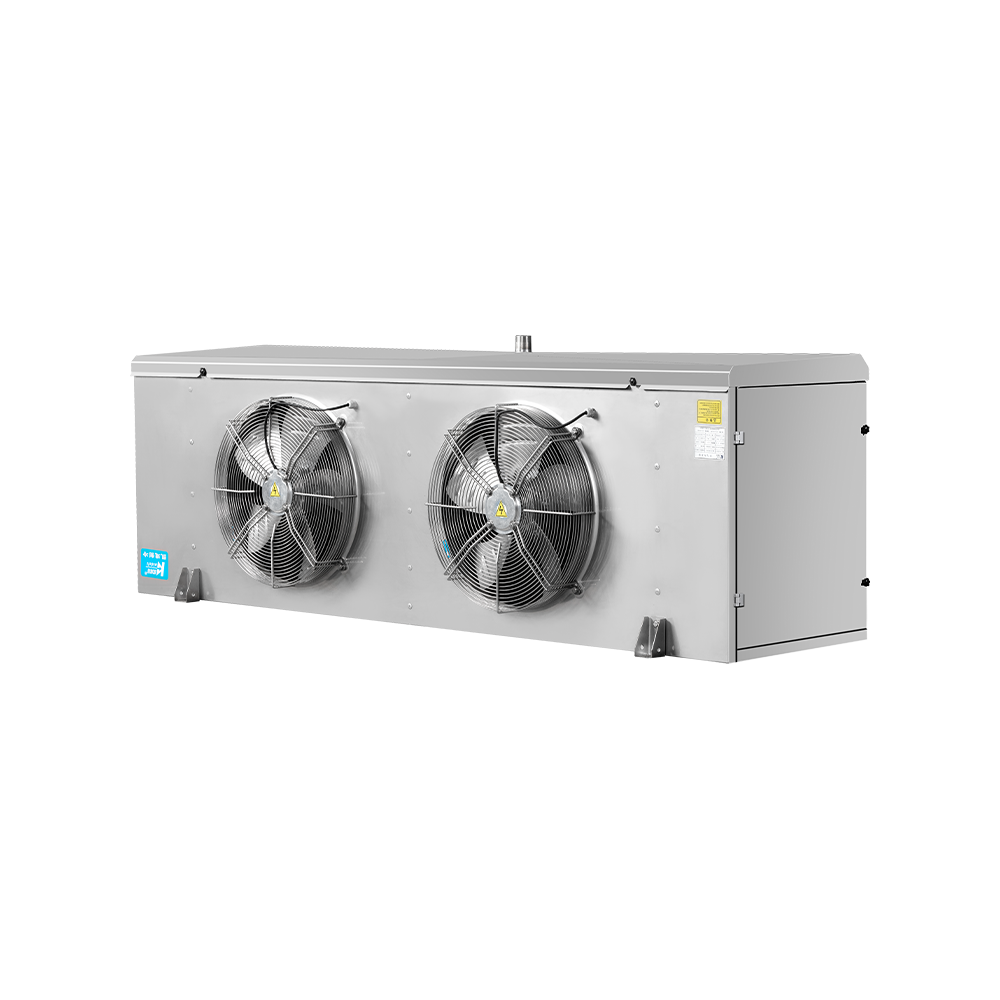
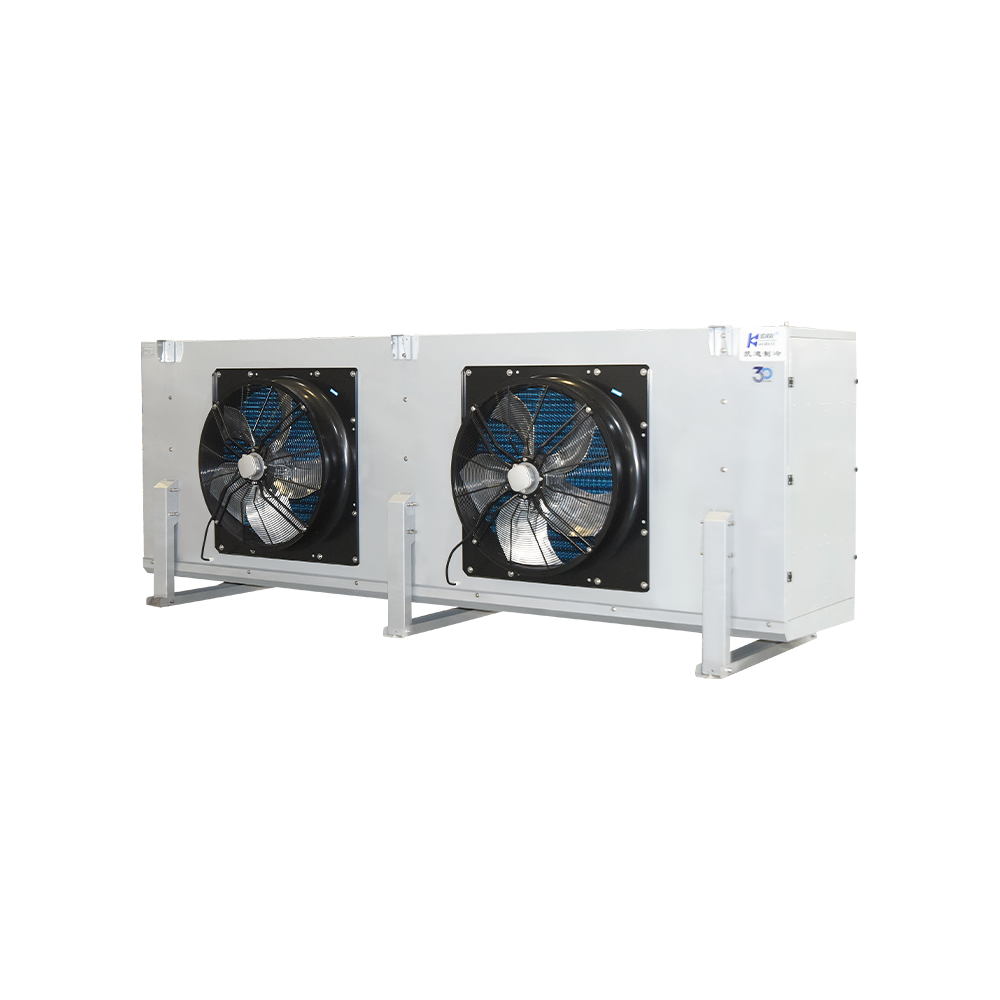
Ceiling-mounted evaporators are the most common choice for small and medium cold rooms. They are installed under the ceiling, saving floor space and providing even air distribution across the room. They typically use axial fans to blow air through the coil and down into the storage area.
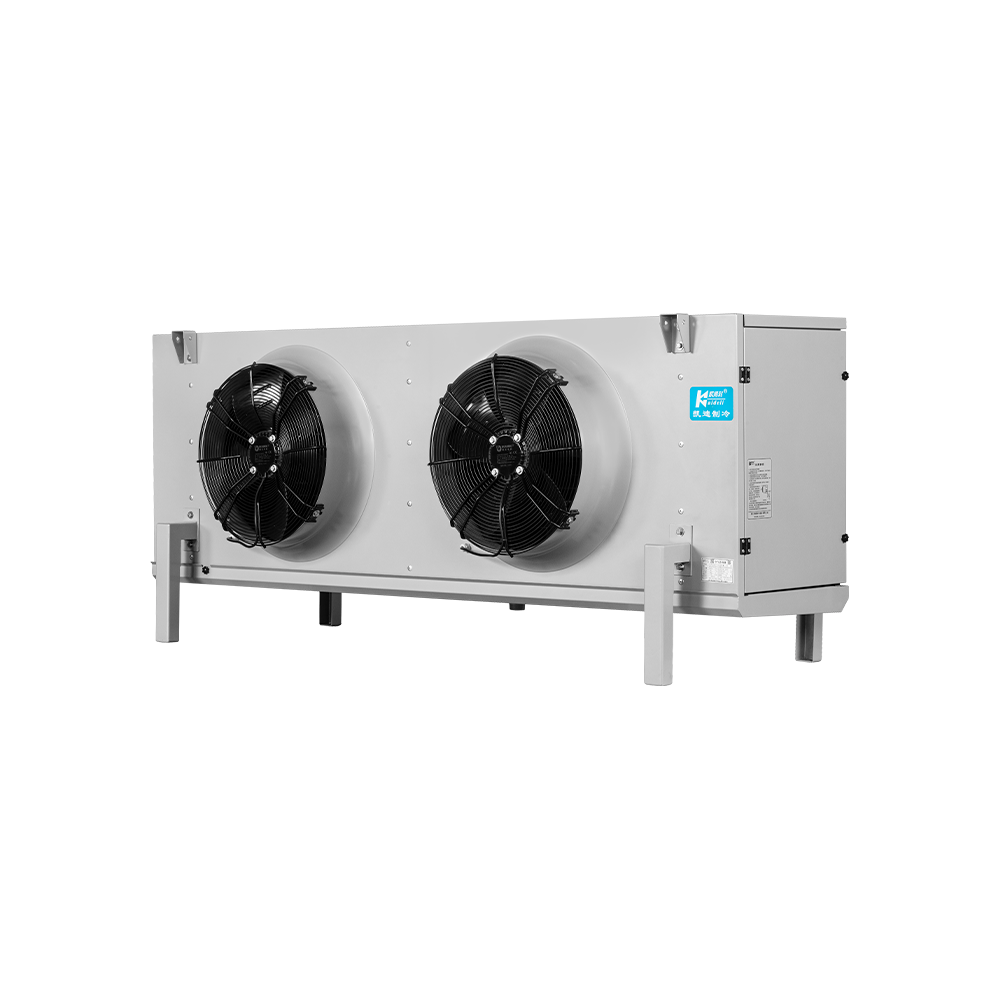 EH Series Ceiling Mounted Evaporator for Commercial Cold RoomsThis ceiling-type evaporator with a high-efficiency coil and corrosion-resistant casing suits small and medium cold rooms, providing even air distribution and easy drainage.View Product →
Double-Side Blow Evaporators for Industrial Facilities
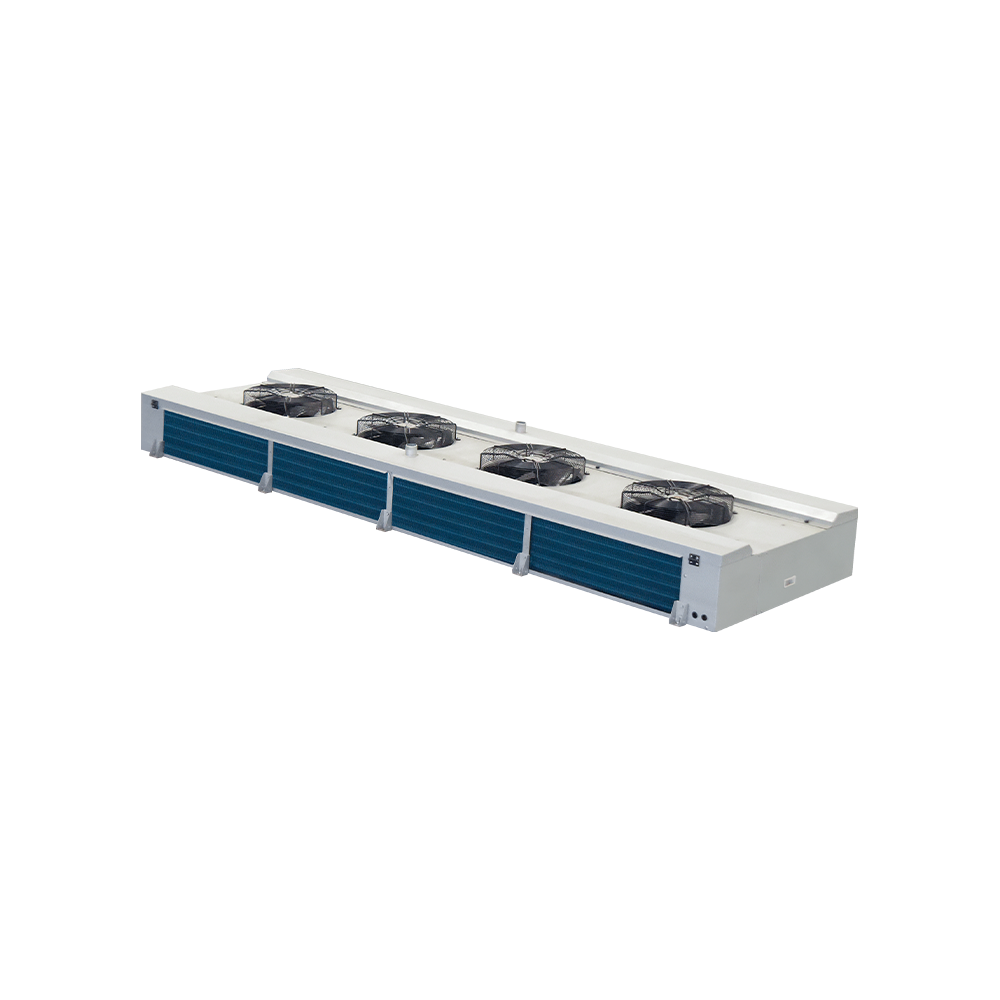
Double-side blow evaporators push air out from two opposite sides, using a central fan and a V-shaped or double-faced coil. This design provides a longer throw distance and is well suited for large industrial cold rooms and blast freezers, where uniform temperature is critical to product quality.
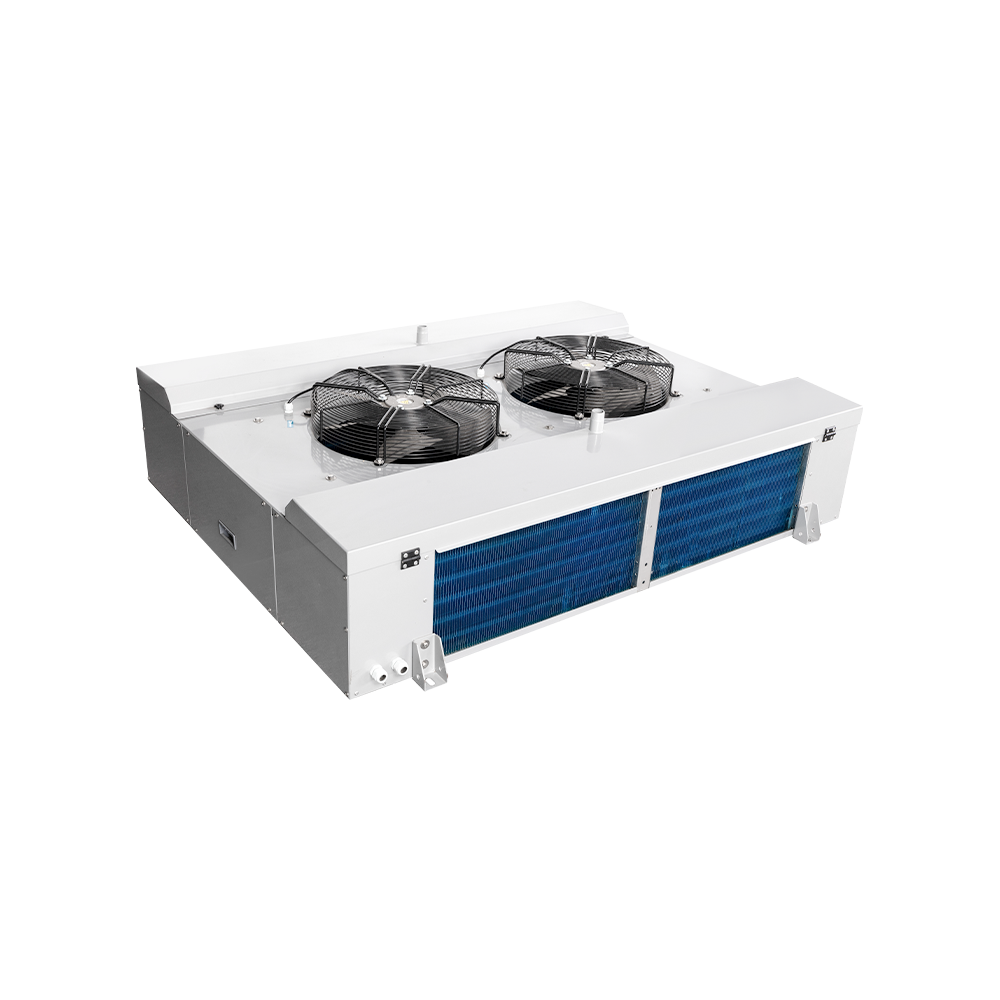 ED Series Double-Sided Blow Evaporator for Industrial Cold StorageDesigned for low-height cold rooms and scenarios without direct blowing, this unit features dual-side discharge and a large heat transfer coil for uniform cooling.View Product →
Floor-Standing Evaporators for Quick Freezing
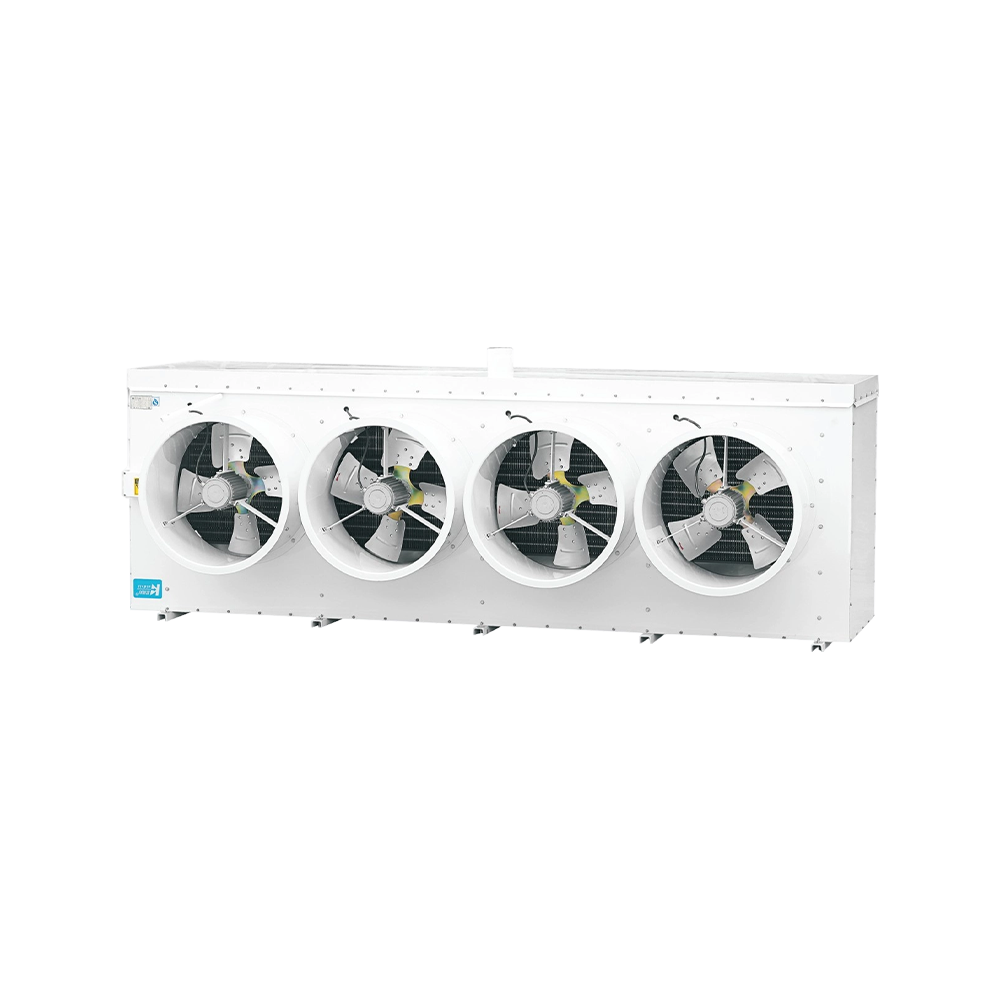
Floor-standing evaporators are designed for applications where the product is placed directly in front of the coil, such as quick-freezing tunnels or trolley freezing rooms. They produce a high-volume, low-temperature airflow that is directed across the product to rapidly remove heat. These units are built with heavier fans and thicker fin spacing to handle the heavy moisture load and frequent defrost cycles.
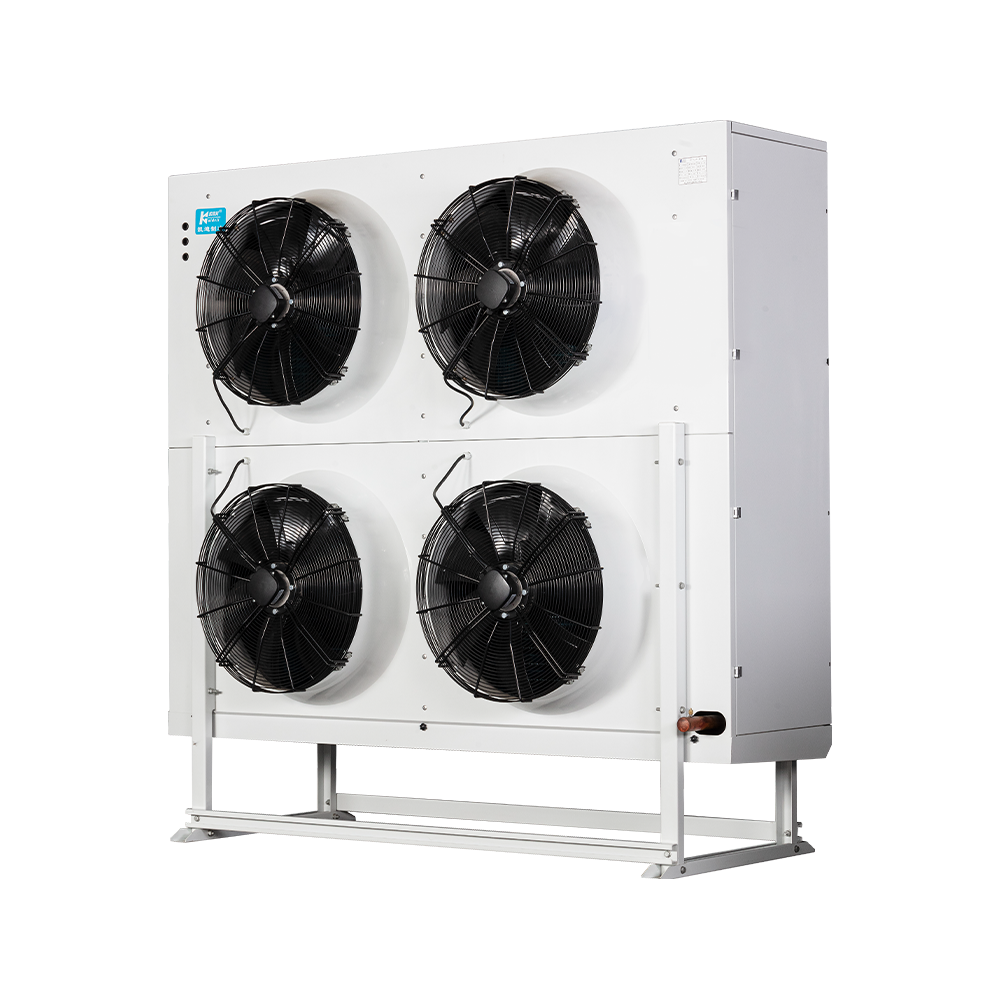 EF Series Floor Standing Evaporator for Quick FreezingIdeal for rapid cooling and low-temperature freezing, this floor unit reduces moisture loss with optimized airflow and supports electric defrost for efficient operation.View Product →
Direct Expansion vs Pump-Overfeed Systems
In a direct expansion (DX) system, the expansion valve feeds just enough refrigerant to the evaporator to achieve the desired superheat. This is simple and cost effective for smaller installations. In a pump-overfeed system, a pump circulates 2-4 times more refrigerant than actually evaporates, ensuring that the tube surface remains wetted. This improves heat transfer, reduces pressure drop, and is commonly used in large industrial freezers where performance and reliability are top priorities.
Selecting an Evaporator: Key Parameters and Common Pitfalls
Choosing the right evaporator is a balancing act. If the unit is too small, it cannot hold the designed temperature. If it is too large, it will short-cycle, cause low superheat, and waste energy. The selection process must consider the following parameters, which are usually provided by the equipment manufacturer.
| Parameter | Typical Range | Why It Matters |
|---|---|---|
| Evaporating temperature | -40°C to -5°C | Determines the refrigerant boiling point and the coil-to-air temperature difference. |
| Air temperature difference | 8-12 K for cold rooms; 5-7 K for freezers | A smaller temperature difference reduces product dehydration but requires more surface area. |
| Fin spacing | 4-6 mm for commercial; 8-12 mm for freezers | Wider fin spacing reduces frost buildup and defrost frequency in low-temperature applications. |
| Airflow rate | 3,000-30,000 m³/h | Higher airflow yields better heat transfer but increases fan energy and noise. |
| Defrost method | Electric, hot gas, or water | Hot gas defrost is more efficient for large systems; electric is simpler and lower cost. |
A common mistake is selecting an evaporator based only on the room heat load and ignoring the latent heat from moisture. In a -25°C freezer with frequent door openings, the latent heat portion can account for 30-40% of the total evaporator load. If this is not accounted for, the evaporator will frost over quickly, defrost cycles will become more frequent, and the room temperature will fluctuate.
If you are not sure about the exact load, contact our engineering team with your room dimensions, insulation details, product throughput, and local climate. A properly matched evaporator will pay for itself in a lower energy bill and longer compressor life.
Evaporator Capacity Calculation: A Practical Example
Let's put the theory into practice with a simple example. Suppose you need to maintain a cold storage room at -18°C with a total calculated cooling load of 12 kW. The room is insulated, and the ambient condition is 30°C with 60% relative humidity. You plan to use R404A with an evaporating temperature of -25°C.
The logarithmic mean temperature difference (LMTD) between the air and refrigerant is calculated as follows:
- Air enters the coil at -18°C and leaves the coil at approximately -22°C (assuming a 4°C drop across the evaporator).
- The refrigerant stays at about -25°C during evaporation.
- LMTD = (ΔT1 - ΔT2) / ln(ΔT1/ΔT2) = ((-18) - (-25)) - ((-22) - (-25)) / ln(7/3) = (7 - 3) / ln(2.33) = 4 / 0.845 = 4.73 K.
If the selected evaporator has a heat transfer coefficient of roughly 35 W/m²K (a typical value for forced-air coils, according to common refrigeration design data), the required surface area is:
Area = Load / (U × LMTD) = 12,000 W / (35 × 4.73) = 72.5 m². You would select a unit with a rated capacity of at least 13-14 kW to account for fan heat, defrost heat, and safety margin. It is also wise to add a 10-15% derating factor for frosting, so a unit with an advertised capacity of 15-16 kW at the design conditions would be a safer recommendation.
Operation, Maintenance, and Troubleshooting
A well-maintained evaporator will operate efficiently for years, but neglect can quickly reduce performance. The three most common issues are frost accumulation, fan motor failure, and improper refrigerant distribution.
Routine Maintenance Checklist
- Clean the fin surfaces regularly. Dust and lint can reduce airflow and heat transfer by 10-20%.
- Check the defrost system. Electric and hot gas defrost heaters should be tested before the high-load season.
- Inspect the fan blades for damage and ensure the motor bearings are lubricated if applicable.
- Verify the refrigerant distributor has even liquid feed. Uneven distribution causes one part of the coil to be liquid-flooded while another part is vapor-starved.
- Check that the condensate drain pan and trap are clear so water does not freeze and block drain lines.
Common Troubleshooting Scenarios
| Symptom | Possible Cause | Action |
|---|---|---|
| Coil is frosted solid | Insufficient defrost cycles, low airflow, or low superheat | Increase defrost frequency, clean the coil, adjust the expansion valve to raise superheat |
| Low cooling capacity | Dirty fins, fan motor spinning slowly, or refrigerant undercharge | Clean fins, check fan speed, measure refrigerant pressure and add refrigerant if needed |
| Noise or vibration | Loose fan blades, worn motor bearings, or unbalanced airflow | Tighten blades, replace bearings, and check that the air grille is not obstructed |
FAQ
What is the main function of an evaporator in a refrigeration system?
The evaporator's main function is to absorb heat from the space or product that is being cooled. It allows the refrigerant to evaporate at low pressure and low temperature, transferring the latent heat of vaporization from the air to the refrigerant. This is the only place in the cycle where useful cold is actually generated.
Why does evaporator pressure matter?
Evaporator pressure determines the refrigerant's boiling temperature for a given refrigerant. If the pressure is too low, the boiling point drops below the design value, which reduces the coil-to-air temperature difference and lowers capacity. If the pressure is too high, the boiling point rises and the evaporator cannot cool the air to the required temperature. Maintaining the correct pressure is essential to system performance.
What is superheat and why is it important?
Superheat is the amount of heat gained by the refrigerant after it has fully evaporated, measured as the temperature difference above the saturation temperature. It is important because it protects the compressor from liquid refrigerant carryover. A typical superheat setting of 5-10 K is used in most commercial systems to ensure safe operation and efficient use of the evaporator surface.
How do I choose the right evaporator for my cold room?
You need to know the total cooling load, the room temperature, the refrigerant type, and the electrical voltage available. Then match the evaporator's capacity at the design evaporating temperature and air temperature difference. Also consider frost formation, defrost method, fan throw distance, and noise. It is always good practice to apply a 10-15% safety margin on the calculated capacity.
How often should I defrost an evaporator?
Defrosting frequency depends on the operating temperature, humidity, and product moisture. In a -25°C freezer with frequent door openings, defrosting every 4-6 hours is common. In a 0°C cold room, 1-2 defrost cycles per day may be enough. The best approach is to monitor the frost thickness on the coil and set the defrost interval so that the frost never becomes thick enough to block airflow.
Can an evaporator work with different refrigerants?
Many evaporators are designed for a specific refrigerant, but they can often be used with other refrigerants of similar pressure and temperature characteristics. However, the capacity and superheat behavior will change. Always check the manufacturer's compatibility chart and confirm that the refrigerant distributor, coil materials, and pressure ratings are suitable for the new refrigerant.
What causes an evaporator to freeze up?
A frozen evaporator is typically caused by three factors: low airflow due to dirty filters or blocked fans, insufficient refrigerant charge, or a defective defrost system. When airflow drops, the refrigerant gets colder than the design temperature, and frost builds up on the coil. Over time, this frost becomes a solid ice block that stops the cooling process entirely.
Conclusion
The evaporator is the heartbeat of every refrigeration system. It performs the essential task of absorbing heat at low temperature, and its design and operating conditions determine how efficiently the entire system runs. Understanding the core principles, selecting the correct type and size, and maintaining the unit properly are the three pillars of reliable cold chain performance.
When you are planning a new cold storage facility or upgrading an existing one, invest time in accurate load calculations and thoughtful evaporator selection. A well-sized evaporator will not only maintain the product temperature but also reduce energy consumption, extend compressor life, and minimize downtime. If you need expert guidance, do not hesitate to discuss your application with a qualified refrigeration engineer.